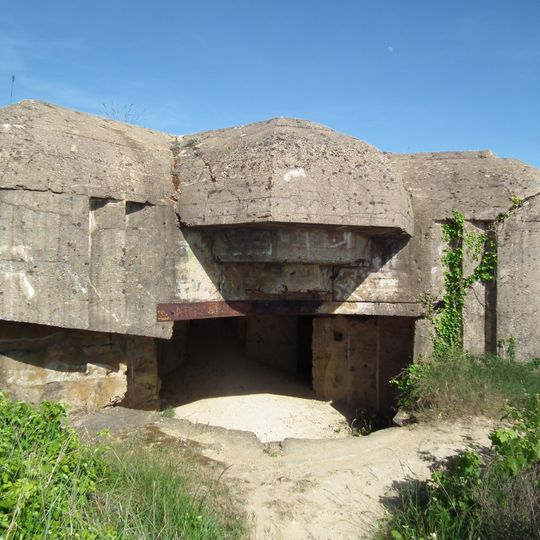
Fort Suzac, Military fortification in Saint-Georges-de-Didonne, France.
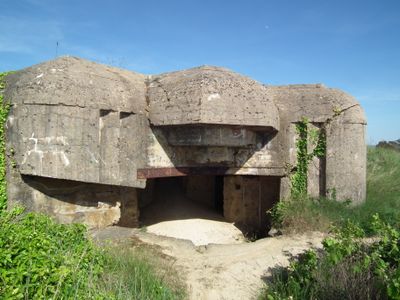
Fort Suzac is a military fortification complex on the Pointe de Suzac in Saint-Georges-de-Didonne. Its concrete casemates, built from 1942 by the Organisation Todt, include a massive block with a rounded dome and a rusted metal beam inscribed "A.F. 1917" above a dark opening. A casemated powder magazine from 1882 still stands, and ivy climbs one wall.
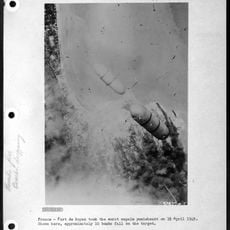
Coastal defences existed here from the 17th century and were strengthened under Napoleon I, who ordered a model 1811 tower armed with twelve cannon. A crenellated guardhouse was built in 1846, then funding voted in 1877 and 1878 paid for new batteries and a casemated powder magazine erected in 1882, which still stands. From August 1942 the Organisation Todt remodelled the site for the Atlantic Wall, adding eight concrete casemates; the garrison surrendered on 15 April 1945.
The name Suzac comes from the pointe de Suzac, the cape the fort was built to defend. After decades of abandonment and brambles, one blockhouse was converted into a dwelling and is still visible. Since the 1990s, marked trails and information panels explain the site to visitors, and some casemates can be entered.
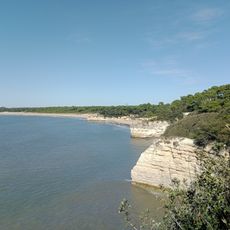
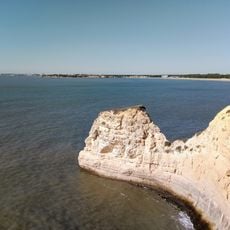
Access to some blockhouses is possible, but the site is dangerous: the cliff at the pointe de Suzac is being eaten away by the sea and wind, so stay back from the edge. Trails and information signs about the fort were laid out in the 1990s. One blockhouse was converted into a dwelling and is still visible.
The walls bear visible impact marks from aerial bombardment in April 1945, when it served as part of the Atlantic Wall defense system. These damage marks remain preserved and document the intense bombing campaign against coastal defenses near the war's end.
The community of curious travelers
AroundUs brings together thousands of curated places, local tips, and hidden gems, enriched daily by 94,001 contributors worldwide.