Fort des Quatre Seigneurs, Military fortification in Herbeys, France
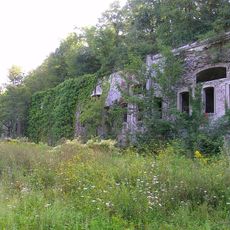
Fort des Quatre Seigneurs is a first-generation Séré de Rivières fort of roughly rectangular plan, built at 937 m on the hill of the same name at the Herbeys–Uriage boundary. Its north-west entrance is framed by two pilasters, with the guardhouse on the left on entering. Behind the head front runs a single-level range of 16 bays, the four right-hand bays rising to two storeys, where powder magazines sat beneath cartridge stores and the artillery cavalier with five shelter traverses. A wide crater marks where the magazines exploded in 1944.
Construction of Fort des Quatre Seigneurs began in 1875 and ended in 1879; it is one of seven forts in Grenoble's fortified belt. It was meant to block enemy troops from reaching Grenoble via the Uriage approaches from Vizille and the Pinet-d'Uriage plateau, and to protect Fort du Mûrier, but military advances of the era meant it never actually served. In 1887 Minister of War Georges Boulanger renamed it Fort Aubert-Dubayet after Jean-Baptiste Annibal Aubert du Bayet, born in La Mobile in 1759, deputy for Isère in 1793 and Minister of War in 1794; the decree was revoked on 13 October 1887 and the fort kept its original name.
The fort's name comes from the Montagne des Quatre Seigneurs, a hill once divided between the mandements of Eybens, Gières, Herbeys and Uriage, marked by a boundary cross. In 1887 Georges Boulanger renamed it Fort Aubert-Dubayet after a general born in La Mobile in 1759, but the decree was revoked that same year and the old name returned.
The fort can be reached from three main starting points: Galochère, Eybens, and Uriage les Bains, with each route involving a climb of roughly 600 to 700 meters over about ten kilometers. Visitors should wear sturdy footwear and bring plenty of water, as the terrain is steep and shade is limited on most stretches.
During decontamination work carried out between 2012 and 2017, workers uncovered more than three million ammunition cartridges from World War I stored within the fort. This massive discovery reveals how extensively the site was used for military storage during the conflict.
The community of curious travelers
AroundUs brings together thousands of curated places, local tips, and hidden gems, enriched daily by 93,111 contributors worldwide.