Fontaine de Mars, Neoclassical fountain in 7th arrondissement, France.
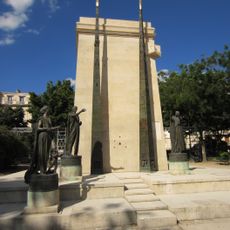
Fontaine de Mars stands in the middle of a small square between 129 and 131 rue Saint-Dominique, facing number 112. It is a square neoclassical block about two metres on each side, framed by fluted engaged columns of the Doric order and topped by a portico roof. The panel facing the street shows Mars beside Hygieia; the other three carry decorative urns. Three bronze mascarons spout water near the ground, and only one still runs.
The Fontaine de Mars was built from 1806 to 1808 to designs by the engineer François-Jean Bralle, with bas-reliefs carved by Pierre-Nicolas Beauvallet, a pupil of Augustin Pajou. It was first called the Fontaine du Gros Caillou, and its water came from the Gros-Caillou steam pump. The arcaded square around it was built in 1859, and the fountain was listed as a monument historique in 1926.
The name recalls Mars, god of war, shown with Hygieia, goddess of health, on the panel facing the street — an unusual pairing explained by the military hospital of Gros-Caillou that stood opposite from 1759 until its demolition in 1896. The fountain was first called fontaine du Gros Caillou.
The fountain sits in a residential area near a main street and is easy to reach on foot. It is wheelchair accessible and provides fresh drinking water on warmer days.
At the fountain's foot, a flood marker records the level the Seine reached in its 1910 flood, even though the riverbed lies 570 m away. The bronze masks spouting water near the ground are the same design as those of the fontaine des Quatre-Saisons on rue de Grenelle; only one still runs.
The community of curious travelers
AroundUs brings together thousands of curated places, local tips, and hidden gems, enriched daily by 92,644 contributors worldwide.