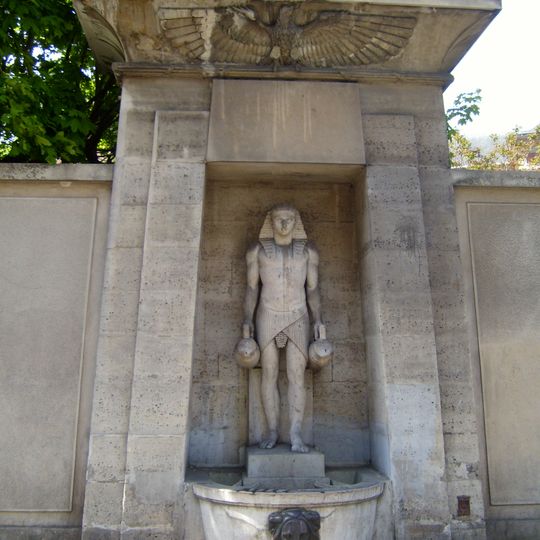
Fontaine du Fellah, Fountain in the 7th arrondissement, Paris, France
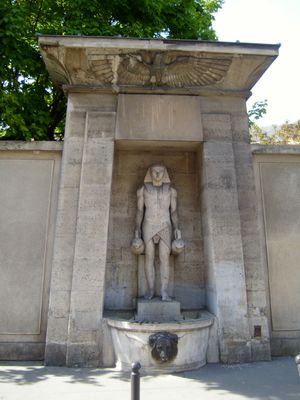
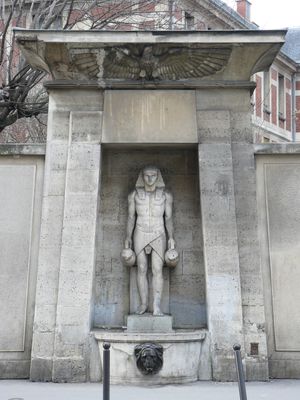
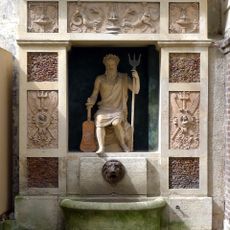
The Fontaine du Fellah is a 2.8-metre-high wall fountain on Rue de Sèvres, built of light grey stone blocks. A carved eagle with spread wings sits above a blank rectangular panel, and a recessed niche holds a life-size statue in Egyptian headdress and pleated kilt, holding a round vessel in each lowered hand. The figure stands barefoot on a plinth above a semicircular basin with a carved head at its centre.
Built in 1806 under Napoleon's rule, this fountain was part of a larger network of 15 water structures distributing water from the Canal de l'Ourcq throughout the city. It represents a key moment in Napoleon's efforts to modernize Paris's water infrastructure.
The name refers to an Egyptian fellah, or peasant, though the statue is thought to depict Antinous, favourite of Emperor Hadrian, after a Roman statue found at Hadrian's Villa in Tivoli in 1739 and kept in the Vatican Museums. The eagle at the top replaces the winged sun disc of ancient Egypt and recalls Napoleon's imperial rule.
The fountain is set into a wall on Rue de Sèvres, beside the Vaneau metro entrance in the 7th arrondissement; the sources give the address as no. 42 (French) or 52 (English). Water was cut off in 2005 because of leaks into the Vaneau station, and after a citizen association took up the project under the 2017 participatory budget, it flowed again from the two jars in August 2019.
The statue is a copy: Jean-François-Théodore Gechter made it in 1930 (or, per another source, 1844) after Beauvalet's original, for a commission of 3,000 francs. A full-scale replica stands in the courtyard of 18 bis rue Henri-Barbusse, where Gechter had his workshop.
The community of curious travelers
AroundUs brings together thousands of curated places, local tips, and hidden gems, enriched daily by 94,087 contributors worldwide.