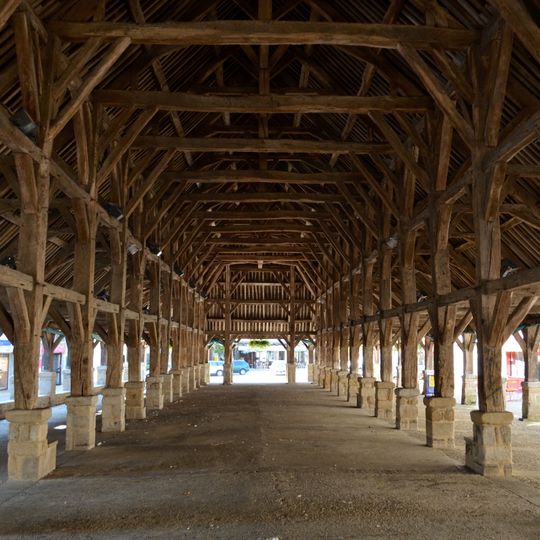
Halles de Questembert, 17th-century market hall in Questembert, France
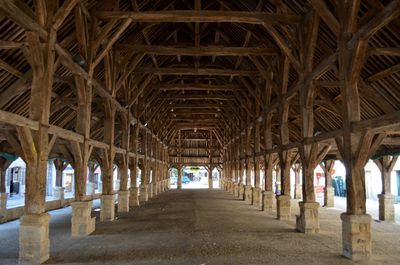
Halles de Questembert is a 17th-century market hall: an oak central vessel of 18 timber bays flanked by open aisles, separated by a series of 80 posts. The posts stand on short squared stone bases, and curved braces rise to tie beams under a pitched slate roof with hipped gable ends. Its church-like interior gives it the local nickname "cathedral".
A first hall, owned in 1552 by Jérôme de Carné, lord of Cohignac, stood on the site of the old Cohue; nothing of it survives. In ruins, it was rebuilt in 1675 by the carpenter Étienne Charpantier, who carved the date "1675" on the tie beam of the ninth truss from the east. The town bought the hall on 13 April 1845 from Hippolyte-Marie-Guillaume de Rosnyvinen de Piré, and it was classified as a monument historique on 18 September 1922.
The market hall remains a gathering place where farmers and locals meet for weekly sales of regional goods like crepes, fish, and cider. People continue to use the space as it was meant to be used, maintaining its role as the village's food and social hub.
The hall is open on all sides, with a flat earthen floor between two rows of posts, so you can walk through at any hour. The weekly regional market is held on Mondays and a local producers' market on Wednesdays. Look for the carved date 1675 on the tie beam of the ninth truss from the east.
The carpenter Étienne Charpantier carved the year "1675" on the tie beam of the ninth truss of the central nave, counting from the east. Look up to find it. The central nave is flanked by 80 oak posts forming market cells, and the building's church-like structure earned it the local nickname "the cathedral".
The community of curious travelers
AroundUs brings together thousands of curated places, local tips, and hidden gems, enriched daily by 93,128 contributors worldwide.