Grand réservoir de Vioreau, reservoir in France
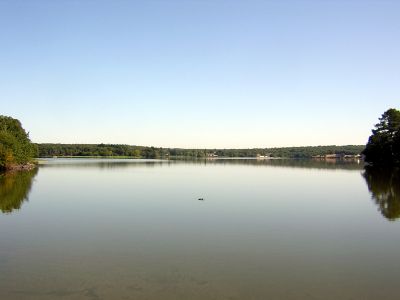
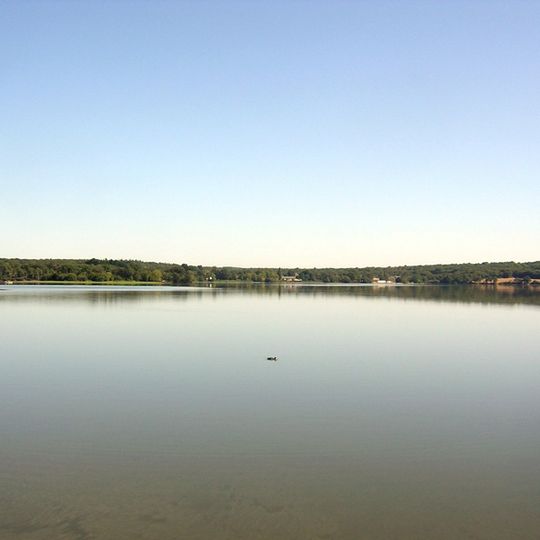
The Grand réservoir de Vioreau is an artificial lake of 200 hectares in Joué-sur-Erdre, usually counted as two parts: the 180-hectare main lake and the 32-hectare Petit Vioreau to its north-east. The main lake lies at an altitude of 31 m and holds up to 7,451,000 m³; the Petit Vioreau holds 504,000 m³. The forest of Vioreau borders the reservoir to the north.
The reservoir was created in the early 1800s to supply water to the Nantes-Brest canal. The dam was completed in 1835 and the canal opened to navigation in 1842, ensuring a steady water supply for this important transportation route.
The reservoir's water feeds the Nantes-Brest canal through a 21.3 km feeder channel, the rigole alimentaire, which runs along the Baillou and Erdre valleys at a gradient of 0.14 mm per metre. It crosses four canal bridges or aqueducts known locally as "les arcades", including the Quiquengrogne, 76 m long with twelve arches, and passes through a 600 m tunnel between Le Châtaigner and Les Noës Bodier.
The reservoir lies in Joué-sur-Erdre, bordered to the north by the forêt de Vioreau. The dam, about 130 metres long, holds back 7,451,000 m³ in the 180-hectare Grand Vioreau; the Petit Vioreau adds 32 hectares and 504,000 m³ to the north-east. The Pont de la Musse, east of the reservoir, shelters two rare or threatened fish species and nationally protected plants on its banks. Water quality is poor, with cyanobacteria and opaque water, so the source advises against water leisure activities.
The Pont de la Musse, a small eastern arm of the reservoir, holds two rare or threatened fish species, and its banks carry several plants protected at national level. The lake also shelters the delicate Coleanthus subtilis, known in the Pays de la Loire from this single site.
The community of curious travelers
AroundUs brings together thousands of curated places, local tips, and hidden gems, enriched daily by 94,110 contributors worldwide.