Hôtel de Limur, Private mansion in Vannes, France
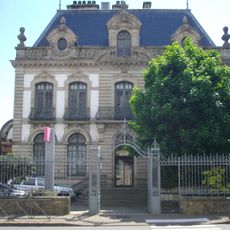
The Hôtel de Limur, also called hôtel des douves, is a private mansion in Vannes built in the 17th century for Raymond Le Doulx, canon of Vannes Cathedral. Its pale stone facade has a central block with two lower wings, a curved pediment and three tall chimneys; a black wrought-iron fence runs in front, and a round-arched stone gateway with a scrollwork iron gate stands to the right. In 1780 Marie-Joseph-Armand de Gouvello enlarged the first-floor bays, added balconies and installed French doors.
The mansion was built in the 17th century for Raymond Le Doulx, a canon of Vannes Cathedral, and was known as the hôtel des douves. In 1780 Marie-Joseph-Armand de Gouvello bought it and enlarged the first-floor windows, adding balconies and French doors. Seized during the Revolution, it housed in 1795 the military commission judging the Quiberon prisoners. The Limur family gave it its present name after acquiring it in 1820.
The mansion now hosts the Architecture and Heritage Interpretation Center, where exhibitions focus on urban development and regional building traditions. Visitors can explore how the city's architectural styles have evolved and shaped the character of Vannes.
The building is in central Vannes, near the old town ramparts whose ditch gave it the name hôtel des douves. Since May 2022 it houses the city's Centre d'interprétation de l'architecture et du patrimoine, so access follows the centre's opening hours rather than those of a private house. The mansion was classified as a monument historique on 9 September 1993.
The building was sold to the State for a symbolic franc in the 1980s, then bought back by the city of Vannes in 1991. It has been classified as a monument historique since 9 September 1993. From 1955 to 1968 it housed the city's museum of fine arts.
The community of curious travelers
AroundUs brings together thousands of curated places, local tips, and hidden gems, enriched daily by 94,575 contributors worldwide.