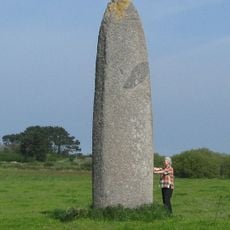
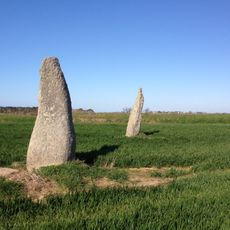
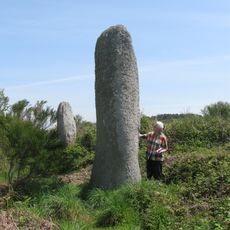
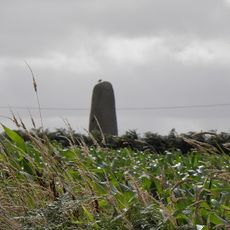
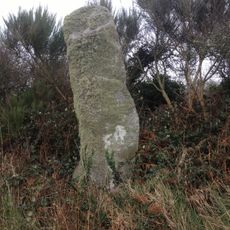
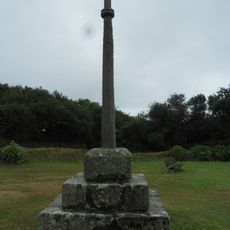
Menhir of Kergadiou, Neolithic megalithic monument in Plourin, France.
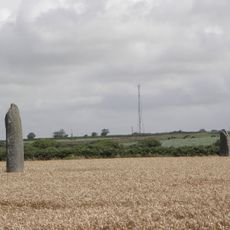
The Menhir of Kergadiou is a granite stone column standing on a hill in Brittany, from a time when people began erecting large stones for ritual purposes. The stone remains intact and rises noticeably from the surrounding terrain.
The Chevalier de Fréminville described the menhir in the early 19th century. It was classified as a monument historique on 25 September 1883. Excavations at its base around 1861 found nothing. The nearby fallen stone may have been abandoned in its setting pit or toppled from an upright position.
A local legend tells that a woman from the British Isles stole the upright menhir from a witch, who in fury hurled a huge block of stone to shatter it; missing by a few dozen metres, the projectile stuck in the ground and became the fallen menhir. The Chevalier de Fréminville described the monument at the start of the 19th century.
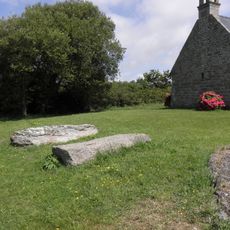
The upright menhir and the fallen stone 75 m to its north-east stand in open grassland on a low hill at 63 m altitude, reached from the road at Plourin. The ground is uneven and the site is exposed to wind and rain, so sturdy footwear and weatherproof clothing help. The two stones lie close together, making both easy to see on one short walk.
The fallen stone measures about 10 m long, against 8.55 m of standing height for its neighbour, and weighs an estimated 60 tonnes. Its upper face was smoothed by hammering while the lower face was left rough, which has led some to argue it was never raised at all.
The community of curious travelers
AroundUs brings together thousands of curated places, local tips, and hidden gems, enriched daily by 94,488 contributors worldwide.