Musée de Tessé, Art and archaeological museum in Le Mans, France
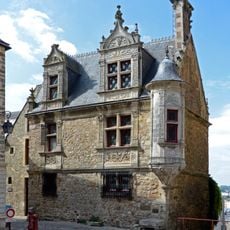
Musée de Tessé occupies a former bishop's palace on the site of Marshal de Tessé's townhouse, built between 1871 and 1877. Its pale grey stone facade carries the word "MUSEE" carved above three arched ground-floor openings, with two rows of rectangular windows and dormer windows in a dark slate mansard roof. A bronze sculpture of two embracing nude figures stands in front. The basement holds reconstructions of the eternal dwellings of Nefertari and Sennefer.
The museum opened free of charge on 21 June 1799 in the galleries of the abbey of la Couture, making Le Mans one of the first French cities with a museum. Its core came from revolutionary seizures of 1792, including some 400 works from the collection of the maréchal de Tessé, whose descendant had emigrated in 1790. The present building is a former bishop's palace erected on the site of Tessé's town house.
The basement holds full-scale reconstructions of the eternal dwellings of Nefertari, wife of Ramesses II, and Sennefer, mayor of Thebes, built for this museum. The Egyptian collection itself is one of the museum's principal holdings, and guided tours on set themes run through the rooms.
The museum stands at the edge of the Jacobins' quincunx and the Tessé park, a short walk from Le Mans old town. Guided tours on several themes are offered; ask at the entrance which ones run that day. The Egyptian rooms, including the reconstructed tombs of Nefertari and Sennefer, are in the specially fitted basement.
The museum's Egyptian holdings include a reconstruction of the eternal dwellings of Nefertari, wife of Ramesses II, and of Sennefer, mayor of Thebes, installed in a specially fitted basement. Until 2009 the building also housed the city's archaeological collections, which then moved to the Musée d'Archéologie et d'Histoire du Mans.
The community of curious travelers
AroundUs brings together thousands of curated places, local tips, and hidden gems, enriched daily by 92,782 contributors worldwide.