Palais Rihour, Gothic palace in Lille, France
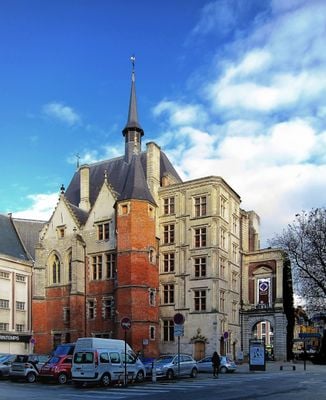
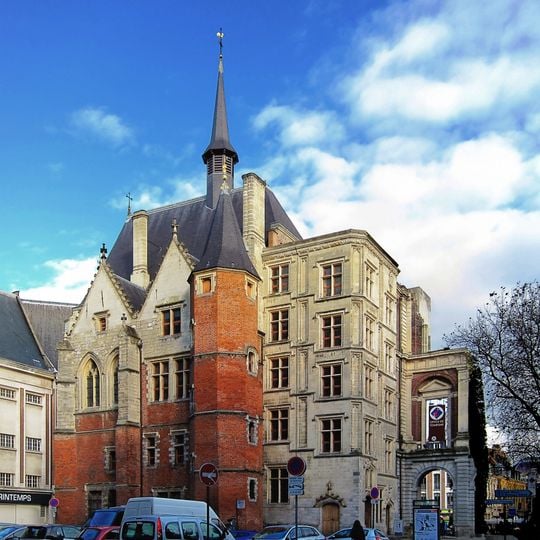
Palais Rihour is the surviving portion of a 15th-century palace built for the dukes of Valois-Burgundy at 42 place Rihour. The remaining late-Gothic elements are the Salle des Gardes, with three octagonal granite pillars supporting a ribbed vault, the upper chapel known as the Salle du Conclave, and the Escalier d'honneur. The chapel measures 18 by 10 metres and has a five-sided choir; its walls hold fourteen basket-handle arches carved with banderoles and the double E of Isabel of Portugal. A brick stair turret, the Tour de la garde des joyaux, projects on the west side.
Philip the Good negotiated subsidies with Lille from 1450 and acquired the marshy Rihour islet in 1453, when work began to plans by Evrard de Mazières; it was finished under Charles the Bold. The city bought it from the King of Spain for 90,000 florins in 1664 to serve as town hall. Fires in 1700 and 1756 damaged the north and west wings, and Charles Benvignat rebuilt it in neo-Renaissance style from 1846 to 1857. A fire in April 1916 destroyed that town hall; only the chapel, the stair and some brick arcades survive.
The upper chapel, called Salle du Conclave, has fourteen basket-handle arches cut into its inner walls, decorated with banderoles and the heraldic emblems of the dukes, including the double "E" of Isabel of Portugal. The States of Walloon Flanders met here yearly, and from 1684 the Magistrat used it as a meeting room. Stained glass of the 15th and 16th centuries, among it a Tree of Jesse window from the Saint-Pierre church of La Couture, is shown in the adjoining sacristy.
The Salle des Gardes, the vaulted guard hall on the ground floor, now holds the Lille tourist office; the 15th-century Salle du Conclave chapel above it can also be visited, though the small stair turret cannot. The building stands at 42 place Rihour, served by the Rihour stop on metro line 1.
The 1916 fire broke out on the second floor during the night of 23–24 April, when the building still served as the town hall. Firefighters reached it late because of the curfew and had only low-pressure water, yet they saved the financial offices and the Salle du Conclave; the 19th-century municipal archives and part of the library collection were lost.
The community of curious travelers
AroundUs brings together thousands of curated places, local tips, and hidden gems, enriched daily by 93,081 contributors worldwide.