Palais archiépiscopal de Besançon, Episcopal palace in Boucle district, Besançon, France
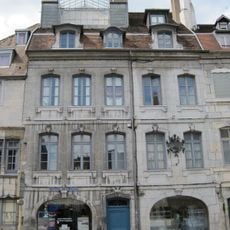
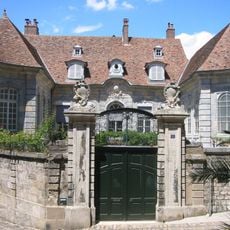
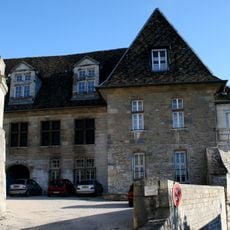
The former archbishop's palace, now the Rectorat de Besançon, stands at 8–10 rue de la Convention. Its pale stone facade has a rusticated ground floor with a round-arched doorway flanked by windows with iron balconies, and an upper storey whose six balconied windows surround a curved pediment carved with a head. Above the door is an oval panel beneath a small bust, and the entrance bears the arms of Archbishop Louis François de Rohan-Chabot, engraved in 1828.
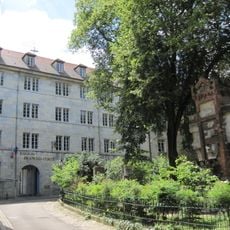
François-Joseph de Grammont, archbishop of Besançon, had his house on Rue de la Convention enlarged between 1698 and 1705 by the architect Jean Cuene. After his death in 1717 it was rented to the archbishops, and in 1735 Antoine-Pierre II de Grammont commissioned Jean-Pierre Galezot to extend it, adding a ceremonial staircase. Sold to a private owner in 1799, it was bought back by the State in 1822 and again became the archbishopric in 1825. A fire on 13 March 1883 destroyed the roof, rebuilt by Edouard Bérard with two hipped ends and decorated dormers; since 1905 the buildings house the Rectorat de Besançon.
The building became the Rectorat de Besançon in 1905, when the separation of Church and State ended its role as an archbishop's residence. The chapel of Saint-Nicolas, inside the palace, has been a listed monument since 18 May 1908. The green "Le Sauvage" sign by the entrance recalls the Comté cheese trade of the street.
The building stands at 8 and 10 rue de la Convention, in the Boucle district, and is seen from the street; the entrance portal carries the arms of Archbishop Louis François de Rohan-Chabot, engraved in 1828. It has housed the Rectorat de Besançon since 1905, so the interior is not open to visitors.
The stone staircase of honour, open to the exterior, is reached from the rear face of the building and has an ironwork railing. It is lined with busts of the archbishops of Besançon, and the entrance portal above which the arms of Archbishop Louis François de Rohan-Chabot were carved in 1828 is decorated with lion heads.
The community of curious travelers
AroundUs brings together thousands of curated places, local tips, and hidden gems, enriched daily by 94,551 contributors worldwide.