Palais de justice de Baugé, Courthouse in Baugé-en-Anjou (Maine-et-Loire)
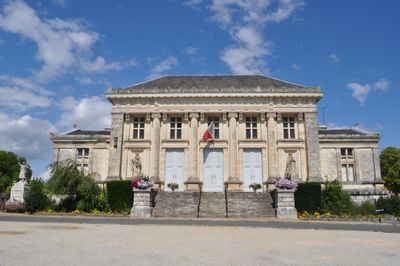
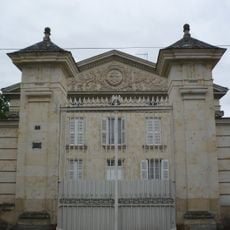
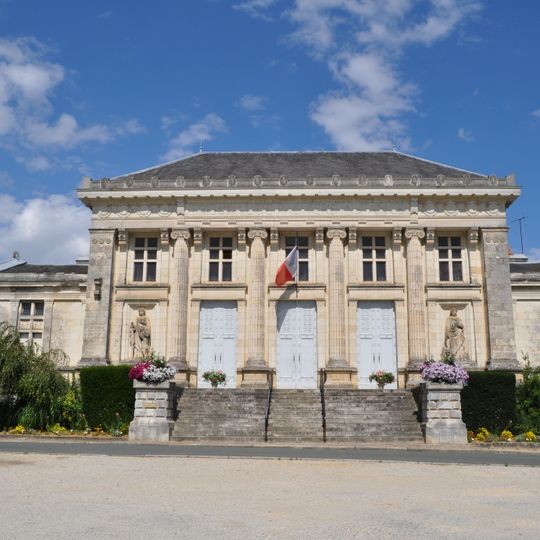
The Palais de justice de Baugé stands on rue du Tribunal, facing the Champ de Foire. Its west-southwest facade of light beige ashlar has six fluted pilasters framing three tall white double doors and three windows above; statues occupy niches on either side. A dark grey hipped roof with a balustrade tops the building, and stone steps flanked by planters lead to the doors. Inside, the hall of lost steps leads to a single courtroom lit by zenithal skylights.
The courthouse was built from 1862 to 1866 to Léon Rohard's design, chosen by competition for a combined tribunal and prison. It replaced a 15th-century royal palace that had stood on the site. The gardens flanking it, enclosed by iron grilles, completed the works in 1867. The building, grilles included, was inscribed as a monument historique in 1986, and in 2020 it was one of 18 sites selected for the Loto du patrimoine by the Bern mission and the Fondation du patrimoine.
The courtroom's blue tapestry with a bee pattern, kept from the Second Empire interior, led director Mathieu Amalric to film the trial scenes of La Chambre bleue (2014), adapted from Simenon's novel, here in November 2013. The salle des délibérations holds a fireplace with a bust of Napoleon III.
The courthouse stands on Rue du Tribunal, slightly south-east of the Château de Baugé and facing the Champ de Foire; its facade opens to the west-south-west. Gardens flank the building on both sides, enclosed by iron gates that are covered by the 1986 listing. The entrance is reached by stone steps up to a landing between the three doors.
The blue tapestry with a scatter of bees in the courtroom is what prompted director Mathieu Amalric to film the trial scenes of La Chambre bleue there in November 2013, adapted from Simenon's novel. The same room holds a fireplace with a bust of Napoleon III, and the woodwork is original to the 1860s.
The community of curious travelers
AroundUs brings together thousands of curated places, local tips, and hidden gems, enriched daily by 92,787 contributors worldwide.