Former courthouse of Caen, Former courthouse in the old centre of Caen, France
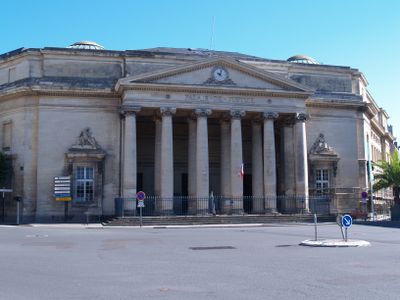
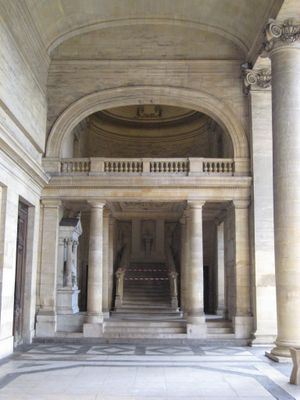
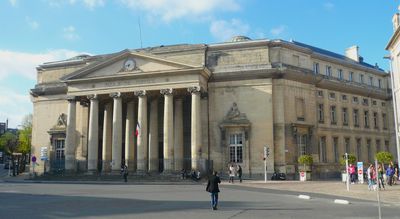
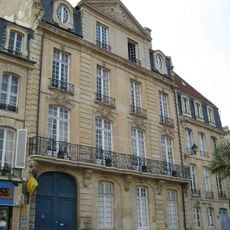
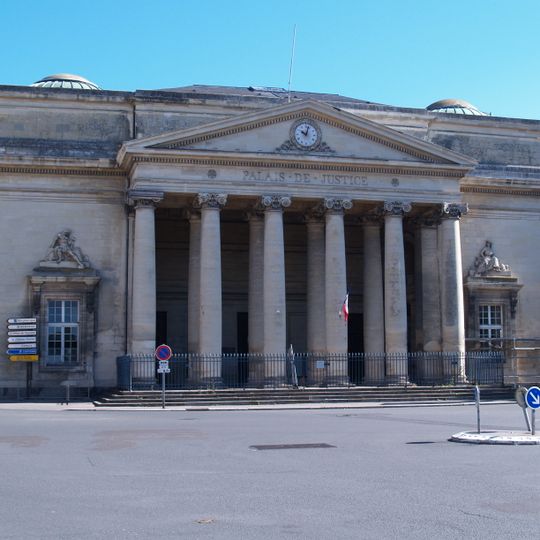
The former Caen courthouse, known as the palais Fontette, is a neoclassical stone building on place Fontette, built between the late 18th and mid-19th centuries. Its main facade has a projecting central section with six plain columns, a triangular pediment with a round clock and the inscription PALAIS DE JUSTICE, and two reclining allegorical figures of La Force and La Loi carved by Léon Falconnier in 1849. A second facade features a large arch above a balustraded balcony and a central stone staircase.
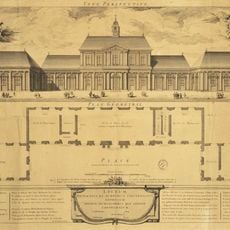
The idea of grouping Caen's bailliage and finance bureau in one building dates from 1758; plans by engineer Armand Lefebvre were approved in 1779, and work began in 1783. The shell was finished in 1789 and courts moved in by 1791, though the building was inaugurated unfinished on 11 February 1792. A second, eastern wing for the royal court, designed by Nicolas-Philippe Harou-Romain, was built from 1831 to 1842. The building was decommissioned in July 2015.
Known as the palais Fontette after the square it faces, the building housed the bailiwick court and later the royal court, civil and criminal tribunals. Two high reliefs of La Force and La Loi by Léon Falconnier were placed on the main facade in 1849, and monuments to jurists Alexandre Carel (1898) and Louis Guillouard (1928) stand at the courthouse staircases.
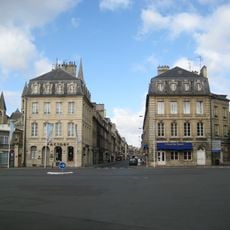
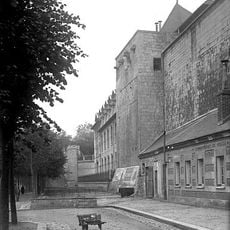
The building is decommissioned since July 2015, so it is not open as a working court. It stands in the old centre of Caen, bounded by rue Saint-Manvieu to the north, rue Bertauld to the west, and the Fontette and Saint-Sauveur squares to the south. The main facade faces place Fontette, where the six-columned portico and the PALAIS DE JUSTICE inscription are best seen from the square.
The building is known as the palais Fontette, after the square it faces. Its south front carries a pediment with a clock and the inscription PALAIS DE JUSTICE, and two allegorical high reliefs of La Force and La Loi were placed on the main facade in 1849, carved by Léon Falconnier.
The community of curious travelers
AroundUs brings together thousands of curated places, local tips, and hidden gems, enriched daily by 93,641 contributors worldwide.