Menhirs d'Époigny, Neolithic menhir alignment in Couches, France
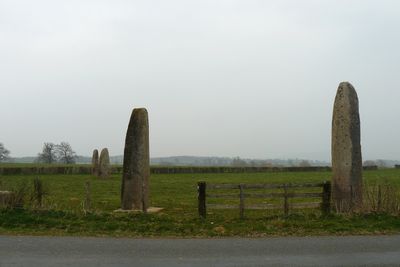
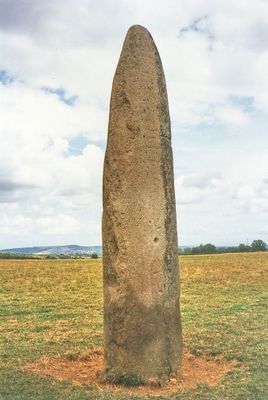
The Menhirs of Époigny consist of seven granite standing stones arranged in a V-shape on a plateau overlooking the Dheune Valley. The largest stone stands approximately 7 meters high and forms the focal point of this Neolithic arrangement.
The menhirs were documented in 1824 by surveyor Roidot-Deléage, who sketched three of the five stones then visible while mapping a stretch of the Via Agrippa 800 m to the north. In 1938 Auguste Goubeau recorded three standing menhirs, two buried and a sixth reused in the parapet of the Vigny bridge in Couches. Two buried stones were located in May 1984 and three menhirs were re-erected that summer by the Histoire et Nature de l'Autunois association, without archaeological excavation.
The engravings on the tallest menhir are only visible under raking light. Its south face, originally the east face, carries a horizontal groove at the top, a schematic human figure about 0.70 m tall with a head, body line, arms and legs ending in cupules, four cupules including a very large one, and a hafted axe 0.35 m high with a pointed heel. The second menhir has two large cupules, one stalked in false relief, resembling the 'object' of Rouergue statue-menhirs.
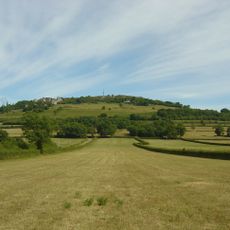
The site sits at 457 meters altitude on an open plateau and is accessible by turning toward Saint-Pierre-de-Varennes from the Autun road coming from Couches. The open location makes it easy to spot and reach on foot once you find the marked area.
The granite blocks originated from the Bouvier massif and were transported across roughly 8 kilometers to reach this plateau, a remarkable feat for Neolithic builders. Some stones weighed up to 30 tons, requiring coordination among many people to move and position them.
The community of curious travelers
AroundUs brings together thousands of curated places, local tips, and hidden gems, enriched daily by 92,938 contributors worldwide.