Phare de Ver-sur-Mer, lighthouse in Calvados, France
The Phare de Ver-sur-Mer is a white-painted lighthouse of rendered limestone rubble, standing in the Baie de Seine on the Calvados coast. Its square tower rises from a short base, topped by a circular gallery with a dark metal railing, a glazed lantern room with green framing and a green domed roof with a ball finial. A single-storey brick building with a pitched roof adjoins it on the left. Inside, a staircase of exactly 51 steps climbs the tower.
A semaphore from the early 19th century preceded the lighthouse, and a first tower was probably raised in 1836; the service date remains uncertain because the Phares et Balises archives were destroyed. In June 1927 the keeper deflected the beam to help the transatlantic plane America, short of fuel, land on the beach. Damaged in 1944, the lighthouse was rebuilt after the Second World War.
The lighthouse also works as a radio beacon, transmitting on 310 kHz under the call sign éR with a range of 20 nautical miles. Its beam, redirected by the keeper, guided the America to an emergency landing on the beach in June 1927.
The lighthouse stands on the Bay of Seine at Ver-sur-Mer, in the Calvados department; the tower is built of limestone rubble coated and painted white. Inside, a staircase of exactly 51 steps leads up to the gallery and the glazed lantern under its green dome. The attached single-storey brick building with a pitched roof sits to the left of the tower.
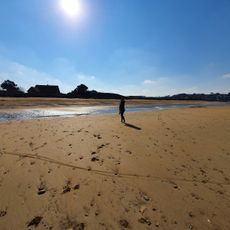
The aircraft that landed at Ver-sur-Mer in June 1927 was the America, one of the first transatlantic planes, not a mail flight. Short of fuel, it came down on the beach, guided by the keeper, who deflected the lighthouse beam toward the landing spot.
The community of curious travelers
AroundUs brings together thousands of curated places, local tips, and hidden gems, enriched daily by 94,457 contributors worldwide.