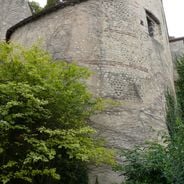
Muséum d'histoire naturelle de Bourges, Natural history museum in Bourges, France.
The Muséum d'Histoire Naturelle de Bourges is a natural history museum in France displaying collections in zoology, botany, and geology across its exhibition space. The collections feature preserved animals, plant specimens, and mineral samples organized by scientific category.
On 24 June 1926 an exhibition at the Palais Jacques-Cœur showed animals that Guy René Babault had brought back from Africa and India. Its success led Canon Gabriel Foucher, an entomologist of Bourges cathedral, to make it permanent: the museum opened on 8 October 1927 in a former municipal gymnasium on rue Michel-Servet. It soon moved to the Parc Saint-Paul, where the Minister of Education Anatole de Monzie inaugurated the new buildings on 26 June 1932.
The permanent galleries are named A chacun sa place, L'univers du vivant, Cosmos destination Berry and Musée de l'Homme. The last traces the evolution of Homo sapiens and the technological steps that changed its environment. Cosmos destination Berry ends with four dioramas of present-day Berry landscapes, and L'univers du vivant keeps live animals in terrariums and aquariums.
The museum stands inside the Parc Saint-Paul, in buildings inaugurated in 1932 and enlarged in 1989, 1994 and 2001. The galleries are spread over several levels, with the permanent displays on biodiversity, the living world, the Cosmos and human evolution, plus a section on bats. Allow time to move between the buildings.
The museum holds the oldest mounted elephant still existing in France: Hans, an Asian elephant seized from Stadtholder William V of Orange in 1795, mounted by Louis Dufresne after his death in 1802. It arrived in Bourges in July 1931 among 28 mounted animals given by the Muséum national d'histoire naturelle.
The community of curious travelers
AroundUs brings together thousands of curated places, local tips, and hidden gems, enriched daily by 93,072 contributors worldwide.