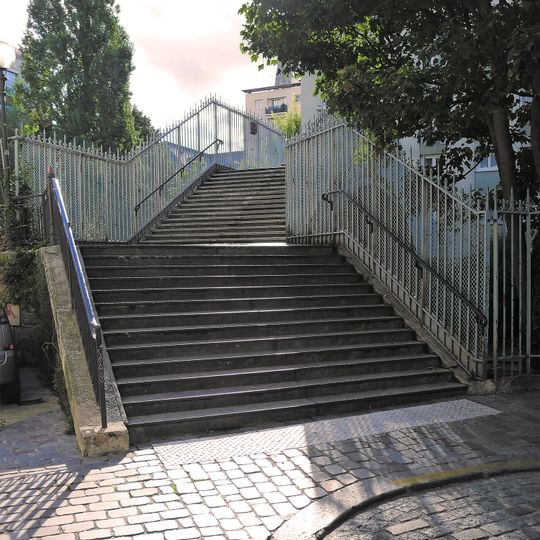
Passerelle de la Mare, pedestrian bridge in the 20th arrondissement, Paris, France
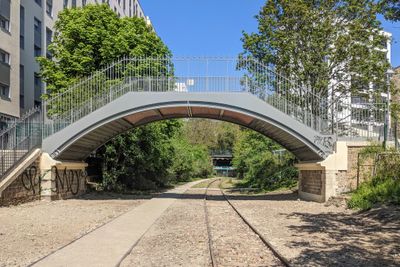
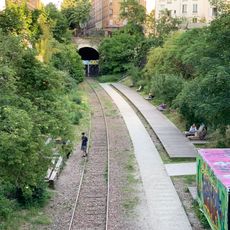
The Passerelle de la Mare is a metal arch bridge in Belleville that spans the former Petite Ceinture railway line and reconnects the two segments of Rue de la Mare. Its simple steel structure reflects the industrial character of the 20th arrondissement.
The footbridge stands on the site of the former Ménilmontant station, which lost its passenger service when the Petite Ceinture closed in 1934. The station was later demolished and replaced by the buildings at 7-11 Rue de la Mare, while the footbridge kept linking the two halves of the street. Judged in poor condition, it was demolished and rebuilt to the same design, with only the railings kept and renovated, for an inauguration in early 2021.
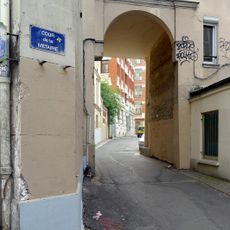
The bridge is named after the Rue de la Mare, whose name recalls an old pond (mare in French) fed by Belleville springs. It appears in Jules Dassin's 1955 film Du rififi chez les hommes, with a scene set on the walkway, and in Willy Ronis photographs published in his 1954 book Belleville Ménilmontant.
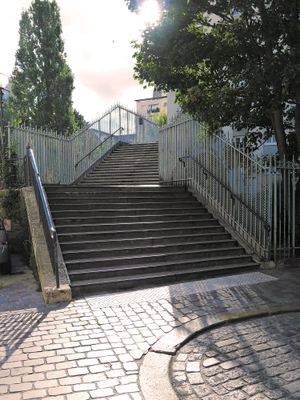
The crossing is made by two straight flights of steps: a wider lower flight of dark grey steps from the cobbled area, then a narrower upper flight aligned with it. Light grey metal railings with pointed vertical bars line both flights and turn horizontal across the landing. The bridge deck is reached only on foot, by stairs.
Willy Ronis photographed the footbridge for his 1954 book Belleville Ménilmontant; the 1999 reissue uses one of these images on its cover. Jules Dassin's 1955 film Du rififi chez les hommes has a scene on the bridge, and Michel Audiard's 1965 La Métamorphose des cloportes shows it twice, with a locomotive whistle and smoke heard though the Petite Ceinture had closed to passengers in 1934.
The community of curious travelers
AroundUs brings together thousands of curated places, local tips, and hidden gems, enriched daily by 93,120 contributors worldwide.