Pont Séjourné, Railway bridge in Fontpédrouse, France.
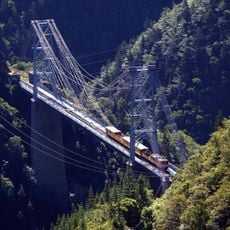
Pont Séjourné is a two-tier stone railway viaduct 236.70 m long, carrying the Cerdagne line over the Têt and the RN 116 at Fontpédrouse. Its central span is framed by two square piers topped with crenellations; the lower tier has a 30 m pointed arch whose keystone meets the intermediate deck, flanked by two secondary arches. Above, four arches with pierced openings support the rail deck, and masonry approach viaducts with round arches close each end.
Engineer Paul Séjourné designed and completed this viaduct from 1907 to 1908 as a key component of the Cerdagne railway line connecting mountain communities. His innovative construction methods became a reference for mountain railway projects of that era.
The bridge crosses the Têt and the RN 116 on the Ligne de Cerdagne, the metre-gauge line built from 1903 to 1910 by the Compagnie des chemins de fer du Midi under Jules Lax. Gérard Raynal's 2012 novel Le pont des illusions sets much of its plot around the bridge's construction.
The structure is best viewed from the road below or from the Yellow Train, which regularly travels across it connecting communities in the region. The road beneath and the train journey both offer different perspectives on the full scale and design of the viaduct.
The two large square piers flanking the central span each hold a mining chamber at their top, reached from the track itself. These were packed with explosives, ready to be blown to cut the line in an emergency. The crenellated tops that visitors notice are the visible edge of this military provision.
The community of curious travelers
AroundUs brings together thousands of curated places, local tips, and hidden gems, enriched daily by 92,812 contributors worldwide.