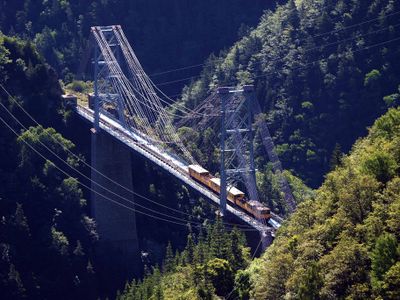
Pont Gisclard, Steel railway bridge in Sauto, France.
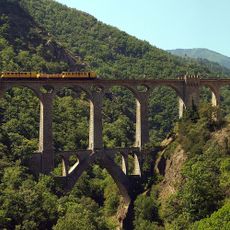
Pont Gisclard is a steel railway bridge over the Têt, with a total length of 253 m and a main span of 156 m. Two masonry piers, 32 m and 28 m high, each carry a 30 m steel lattice pylon; thin cables fan from the pylon tops to the single-track deck, which crosses the river 80 m above the water on a continuous 60 mm/m gradient.
Albert Gisclard designed this bridge in 1896, and Ferdinand Arnodin's company built it between 1905 and 1908 as part of the Ligne de Cerdagne railway line. It was classified as a historical monument in 1997.
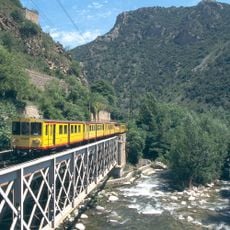
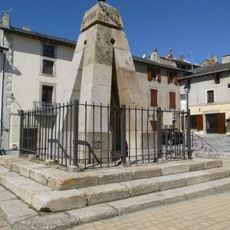
The bridge is also called Pont Gisclard after Albert Gisclard, who died in the 1909 derailment that killed six people after the load tests. A plaque on Route Nationale 116 lists the victims, and a stele commemorating Gisclard was inscribed as a monument historique on 11 April 1995. Passengers on the Yellow Train can see the bridge up close.
The bridge is best viewed from viewpoints along the river or from the train that still uses it. The easiest access for visitors is from Villefranche-de-Conflent station, where you can see the structure and its surroundings.
The upper stay cables cross each other well past the middle of the span, a layout specific to Gisclard's 1896 design. The deck is stiffened by triangulated, non-deformable trusses forming an isostatic system, a forerunner of modern cable-stayed bridges. The cables themselves were made by Arnodin's alternating-torsion process.
The community of curious travelers
AroundUs brings together thousands of curated places, local tips, and hidden gems, enriched daily by 93,765 contributors worldwide.