Bridge of Constantine, Roman bridge in Arles, France
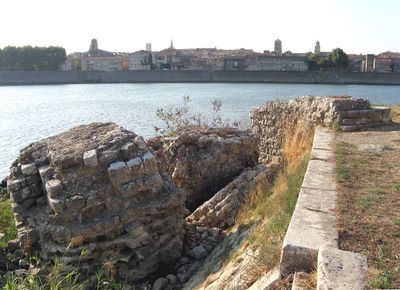
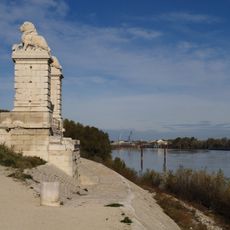
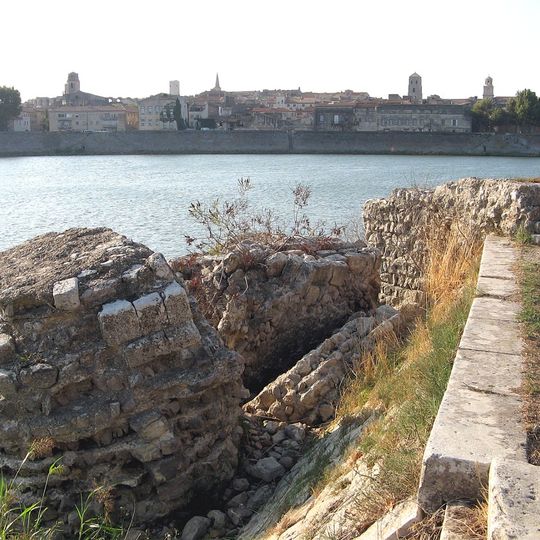
The Bridge of Constantine survives only as reduced ruins at Trinquetaille, on the right bank of the Rhône in Arles. The visible masonry is built from small, irregular grey stones set in mortar: a rounded pier-like mass of stacked blocks topped by two larger, smoother pale rectangular stones, a lower broken section with a gap and ledge, and a low uneven wall bordered by dry grass. The bridge itself combined stone abutments at each end with a wooden boat bridge across the middle.
This bridge was built during Roman times when the empire controlled southern France and needed strong transportation links across major rivers. It served as a crucial passage for merchants and armies moving through the region for centuries.
The name Bridge of Constantine comes from Emperor Constantine I, who had the two stone abutments rebuilt; the river crossing itself was a pontoon bridge of boats joined with iron clamps. Ausonius, writing between 380 and 390, described a boat bridge with a central platform where goods from the Roman world were received. In 428 the pontoon collapsed under crowds crossing for the feast of Saint Genès, with no victims reported.
Only reduced ruins of the bridge remain, on the Trinquetaille bank of the Rhône in Arles; the river crossing itself no longer exists. The visible masonry was consolidated after a 2009 excavation and integrated into the quay, so it can be viewed on foot from the riverside. Look for the rounded pier mass with its two pale rectangular stones.
The visible remains at Trinquetaille are only the right-bank bridgehead; the left-bank pier was demolished for Arles' medieval walls, and the pontoon section vanished after the 10th century. The masonry was re-laid under Constantine I, which gave the bridge its name.
The community of curious travelers
AroundUs brings together thousands of curated places, local tips, and hidden gems, enriched daily by 94,013 contributors worldwide.