Puits Rodolphe I et II, Historic headframe in Ungersheim, France.
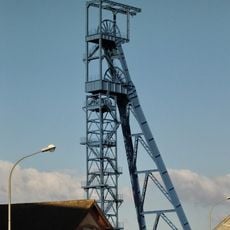
Puits Rodolphe I and II near Ungersheim comprises two mining shafts constructed with different materials, the first featuring a steel headframe and the second using reinforced concrete. The two installations enabled potash extraction at considerable depths with modern hoisting equipment.
Sinking of shaft Rodolphe I began in January 1911 and reached potash at 694.25 metres, ending at 711 metres in 1913; its steel headframe was built in 1911-1912 by Zehne-Tscheille. A munitions depot explosion in World War I damaged the mining installations but spared the headframe, which returned to service in 1919. Shaft Rodolphe II was sunk from 19 June 1925 to February 1928, 744 metres deep, with a reinforced concrete headframe by Zublin-Perrière; shaft I then handled ventilation. Extraction stopped on 9 July 1976 and both shafts were backfilled in 1984.
The site's name comes from the Rodolphe shafts, and the surviving headframes are now the centre of a mining heritage group, Le Groupe Rodolphe, founded in 1994. Visitors can see the restored winding engines and the last integral coal cutter of the basin, machines listed in the inventory of the museums of France.
The site is visited on guided tours run by the Groupe Rodolphe association, created in 1994, which restored the hoisting machinery of shaft II between 1999 and 2005. The grounds lie between Ungersheim and Pulversheim, and the two headframes stand side by side, so allow time to walk outdoors between the buildings.
The two shafts display different construction styles from their respective eras, with the first using steel structures typical of the 1910s while the second employed modern reinforced concrete technology. These side-by-side structures reveal how mining engineering advanced significantly within a single decade.
The community of curious travelers
AroundUs brings together thousands of curated places, local tips, and hidden gems, enriched daily by 92,922 contributors worldwide.