Place Monge, square in Paris, France
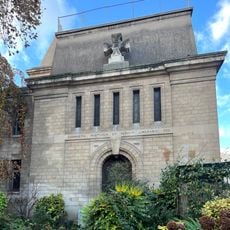
Place Monge is a paved square between rue Gracieuse and rue Monge in the 5th arrondissement. Its surface mixes large dark slabs with scattered small pale rectangular tiles, and leafless trees grow from round openings, two enclosed by low cylindrical metal grilles. A tall dark fluted lamppost and a short black bollard stand near the left, facing a pale stone building with a central arched entrance flanked by columns.
Place Monge was created in 1859 by absorbing the former rue Triperet; the name, taken from the neighbouring rue Monge, honours mathematician Gaspard Monge. The square was officially named on 26 February 1867. A statue of journalist and historian Louis Blanc by Léon-Alexandre Delhomme stood here until it was melted down in 1942 for the non-ferrous metal mobilisation.
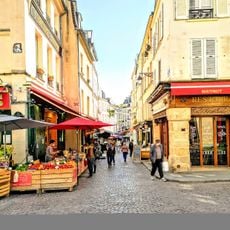
The square is named after Gaspard Monge, an 18th-century mathematician whose memory connects the city to its scientific past. Today, a weekly market on Wednesdays, Fridays, and Sundays brings locals and visitors together to buy fresh produce and goods, forming part of the neighborhood's daily routine.
The square is easy to reach via the nearby Metro station also called Place Monge, and several surrounding streets are walkable from here. The area itself is car-free, allowing you to stroll and spend time without worrying about traffic.
A statue of journalist and historian Louis Blanc by Léon-Alexandre Delhomme once stood on the square; it was melted down in 1942 under the wartime requisition of non-ferrous metals. The square also gives its name to two novels, Jean-Yves Laurichesse's Place Monge and Laure Malaprade's Métro Place Monge, and Kieslowski filmed scenes of La Double Vie de Véronique here.
The community of curious travelers
AroundUs brings together thousands of curated places, local tips, and hidden gems, enriched daily by 92,796 contributors worldwide.