Pont Charlemagne, Stone bridge in Mijoux, France.
Pont Charlemagne is a single-arch road bridge of grey rectangular stone blocks carrying the D436 over the Valserine at Mijoux, on the boundary between the Jura and Ain departments. Its flat top has a low dark metal railing, and the rounded arch springs from vertical abutments, with the stonework running down to the waterline on both sides.
In 1476 the bridge was allegedly used by the kidnappers of Yolande de France, sister of Louis XI, men of Charles the Bold. In 1613 boundary stones were set here, separating the Pays de Gex, French since the 1601 Treaty of Lyon, from its neighbour. From 22 June 1940 it was a crossing point on the demarcation line between the free zone on the Jura side and the occupied zone on the Ain side, with a pass required.
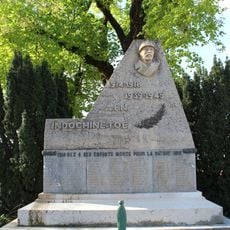
A stone stele stands halfway across the bridge, its main face engraved with a chronological account running back to Charlemagne's empire, while its left side honours Michel Hollard and Denis and Alice Poncet. The Poncets' farm, La petite Bachaudie, lies about 3 km away.
The bridge is accessible via the D436 departmental road which serves as the main transportation route through the area. The location is open to both pedestrians and vehicles, and the surroundings offer easy access to the river valley.
Michel Hollard, an AGIR network resistance member, did not cross at the bridge itself: from summer 1943 he forded the Valserine about 3 km away, near the Poncet farm called "La petite Bachaudie", to reach the British embassy in Berne. A stele at mid-bridge honours him and Denis and Alice Poncet.
The community of curious travelers
AroundUs brings together thousands of curated places, local tips, and hidden gems, enriched daily by 93,119 contributors worldwide.