Square de la Madone, Urban park in 18th arrondissement, Paris, France
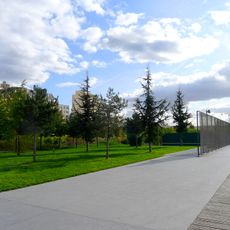
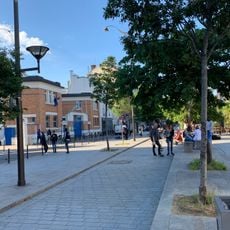
Square de la Madone is a park in the Chapelle neighbourhood of Paris's 18th arrondissement, bounded by rue des Roses, rue de la Madone and rue Marc-Séguin. A green metal fence with vertical bars and a gated central section runs along a paved sidewalk lined with short black posts. Inside are bare trees and low ground vegetation; a white-banded building with a blue awning stands behind the fence.
The square was proposed to the Paris municipal council on 30 December 1924 by Joly and Louis Sellier, who argued that the northern railway's occupation of the old fortifications would deprive local neighbourhoods of air and open space. It opened in 1937 as square Hébert and later took its current name. Around 2000 a new artesian well was drilled there to reach the Albien aquifer, replacing the unusable 19th-century well of place Hébert.
The name comes from the nearby rue de la Madone, which Swedish sources link to a statue of the Madonna and Child. The square opened in 1937 as square Hébert and was later renamed. A fountain installed in February 2001 carries an inscription recounting the 1863 drilling of the place Hébert artesian well and its 1883 water strike at 719 metres.
The grounds are easy to reach on foot and sit near several metro stations, making arrival straightforward. It is a good idea to visit during the day to see the gardens in natural light and take advantage of shaded areas when the weather is warm.
The square's artesian well taps the Albien aquifer at 740 metres; a fountain installed in February 2001 offers this water free. It replaces a first well drilled at square Paul-Robin from 1841 to 1864, where water was reached at 719 metres in 1883 and fed the municipal swimming pool built in 1895.
The community of curious travelers
AroundUs brings together thousands of curated places, local tips, and hidden gems, enriched daily by 93,783 contributors worldwide.