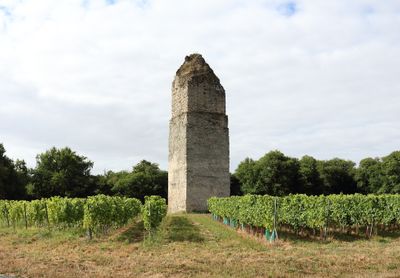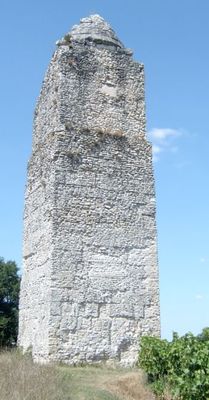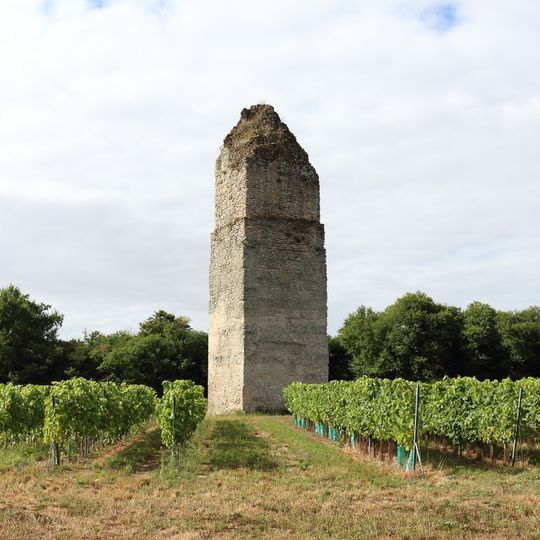
Tour de Pirelonge, Roman monument in Saint-Romain-de-Benet, France.
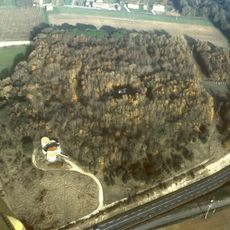
The Tour de Pirelonge is a solid Gallo-Roman funerary pile: a square tower 24 m high and about 6 m wide at the base, narrowing slightly at two points as it rises, with each face turned to a cardinal point. It is built of rubble stone bound with mortar, and its conical cap survives; the large ashlar facing has disappeared. It stands in a vineyard south of Saint-Romain-de-Benet.
The tower's foundations contain reused material, including a capital datable to the 1st century AD, so construction came later, probably under the Antonine emperors. Claude Masse described it in 1715 in a state close to its 20th-century condition. It was listed as a monument historique in 1840 and restored in 1989.
The name Pirelonge comes from a term meaning "long stone" or "tall stone", a label often given to funerary piles. The tower is one of three such piles in the civitas of the Santons, with the Pile d'Ebéon at Authon-Ébéon and the Pile d'Aumagne, all near the ancient Poitiers–Bordeaux road. At its foot, excavations found a funerary enclosure on three sides.
The monument sits in open countryside surrounded by vineyards and woodland, easily accessible on foot for visitors. There are no facilities nearby, so it is best to plan a visit during fair weather and bring what you might need.
The tower is solid: surveys found no inner chamber, so it is a cenotaph, not a tomb. The burials of the late 19th-century excavations lay outside it, within a three-sided enclosure at its base. Treasure hunters dug into the east and south faces; their pits were filled during the 1989 restoration.
The community of curious travelers
AroundUs brings together thousands of curated places, local tips, and hidden gems, enriched daily by 93,690 contributors worldwide.