Château de Saujon, Medieval castle in Saujon, France.
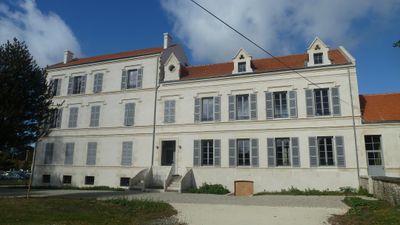
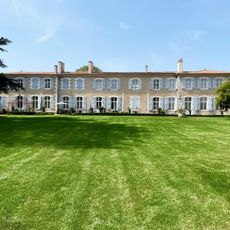
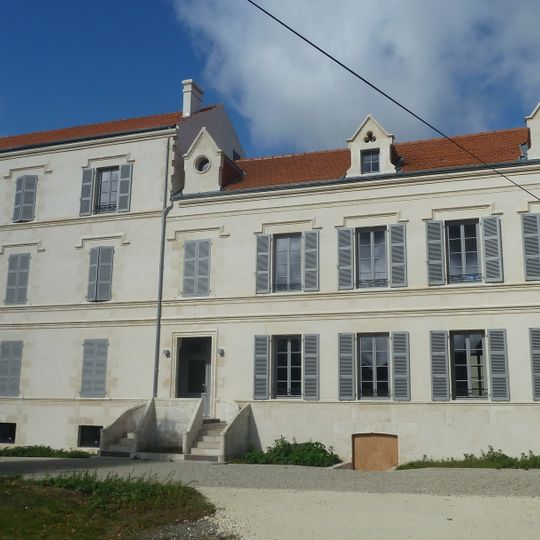
Château de Saujon is a long, pale cream stone building with a red clay-tiled roof, its facade set in regular rows of tall windows with pale grey louvred shutters. Above the roofline stand three dormers: a projecting tower at left with a round window, and two matching gabled dormers with square windows. A symmetrical stone staircase with a solid balustrade rises to a recessed central doorway, and two small dark openings sit low on the left wall.
A fortress at Saujon is first mentioned in the 9th century, when its guard was entrusted to Taillefer de Léon, Count of Angoulême. A castle is recorded as ruined in Edward III's Gascon Rolls of 1331, and the site was probably lost around 1439-1442 during the pillaging of the town. In May 1475 Louis XI authorised Olivier de Coëtivy to build a castle with walls, drawbridge and moats west of the Seudre.
The castle is sometimes called château de Richelieu, after the cardinal who owned it from 1638 to 1642. Its 15th-century origin is tied to Olivier de Coëtivy, who in May 1475 received Louis XI's permission to build a castle with walls, a drawbridge and ditches at Saujon. The seigneurie later passed to the Protestant Campet family.
The castle serves as a venue for educational and community events that visitors can attend. Check local tourism information for current opening hours and programs before planning your visit.
The castle is also called château de Richelieu, after the cardinal who owned it from 1638 to 1642. Before him, the Protestant lord Denis de Campet held it: in 1577, after royal troops took Saujon, he left Brouage with 200 arquebusiers and 30 horsemen and captured the enemy vanguard's commanders at the port of Ribérou.
The community of curious travelers
AroundUs brings together thousands of curated places, local tips, and hidden gems, enriched daily by 94,304 contributors worldwide.