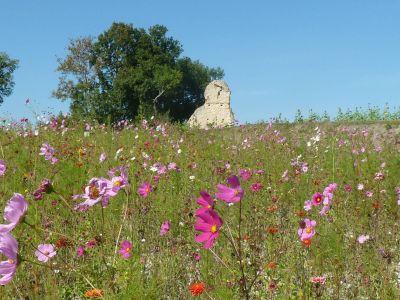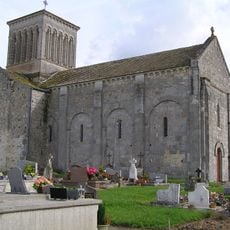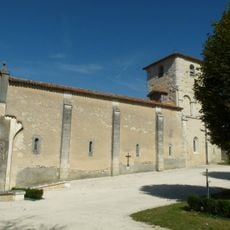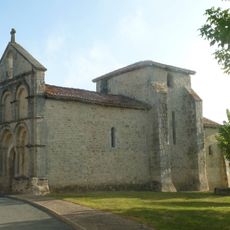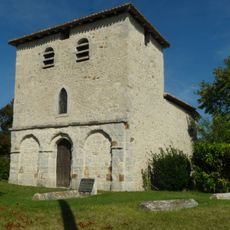
Villa of Lacou Dauzena, remains of a Gallo-Roman villa in the commune of Brossac
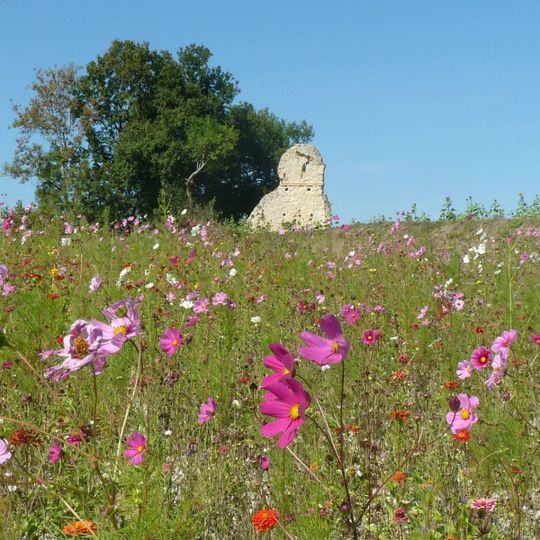
The Villa of Lacou Dauzena at Brossac preserves three thick wall sections, the tallest standing 7.50 m high, of a Gallo-Roman villa oriented south-east to north-west. The main building measured 57.40 m by 22 m, with a floor level marked by a 2.85 m base. Fragments of mosaics and a lead-pipe aqueduct were found by Abbé Michon in 1844.
The villa was built before the 2nd century during Roman times, making it over 1800 years old. The site was officially protected as a historical monument in 1875, and the aqueduct received the same protection status a few years later.
The name 'La Coue d'Auzenat' comes from a local expression meaning 'the walls of Ouvenac', a name used by people in the area for centuries. This connection to local naming traditions shows how the ruins have remained part of the community's awareness and identity over time.
The ruins stand in a field of tall grass and cosmos flowers about 1 km east of Brossac toward Brie-sous-Chalais, at the spot called La Coue d'Auzenat. The main remains are three thick wall sections, the tallest reaching 7.50 m, so watch your footing on the uneven ground. The aqueduct lies 62 m north of the villa.
Abbé Michon, who described the villa in 1844, found fragments of a lead pipe inside the aqueduct that ran 62 m north of the villa. The pipe carried water from the Fontenelles spring about 1 km away, near the hamlet of Chez Rabanier. The spring is one of the sources of the Viveronne, a tributary of the Tude at Chalais.
The community of curious travelers
AroundUs brings together thousands of curated places, local tips, and hidden gems, enriched daily by 93,149 contributors worldwide.