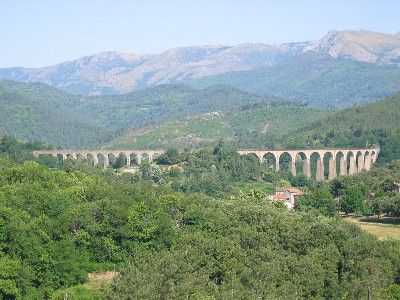
Viaduc, Railway bridge in Chamborigaud, France.
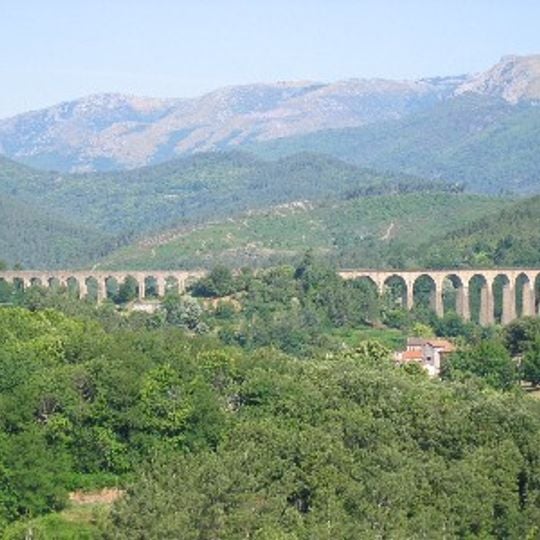
The Viaduc de Chamborigaud is a single-track masonry railway bridge on the border of Chamborigaud and Chambon in the Gard. It spans the Luech valley in a curve, with 29 arches: 12 of 14 m span in the north and 17 of 8 m in the south. It is 384 m long and 46.3 m high, built of light grey stone in two tiers of round arches.
Construction began on 1 October 1865 and finished on 1 May 1867. The engineer Charles Dombre, assisted by Joubert and Ruelle, designed the viaduct for the Compagnie des chemins de fer de Paris à Lyon et à la Méditerranée (PLM). A more ambitious alignment avoiding the Luech crossing was rejected to save money, so the line takes the tight curve and 25‰ gradient seen today.
The viaduct is also called the viaduct du Luech after the river it crosses. Its curve turns its back on the downstream valley, and the line climbs a 25 per mille ramp at the foot of the structure, which limits train speeds. The northern six arches and a half-arch lie in the commune of Chambon.
The viaduct curves through the Luech valley between Chamborigaud and Génolhac stations, so the full span is best seen from the valley floor or the slopes on either side. The structure is a listed monument and cannot be walked; trains still cross it, and the tight 200 m curve on the southern part keeps speeds low.
The northern section follows a wider curve with a 240-meter radius, while the southern section tightens to a 200-meter radius. This variation shows how engineers adapted the track layout to fit the valley's natural shape.
The community of curious travelers
AroundUs brings together thousands of curated places, local tips, and hidden gems, enriched daily by 92,920 contributors worldwide.