Viaduc de Saint-Chamas, Railway viaduct in Saint-Chamas, France.
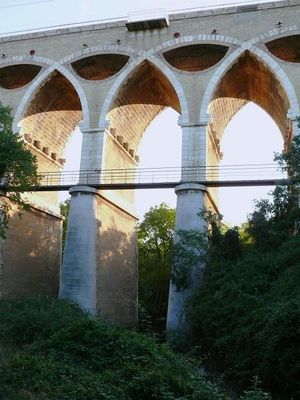
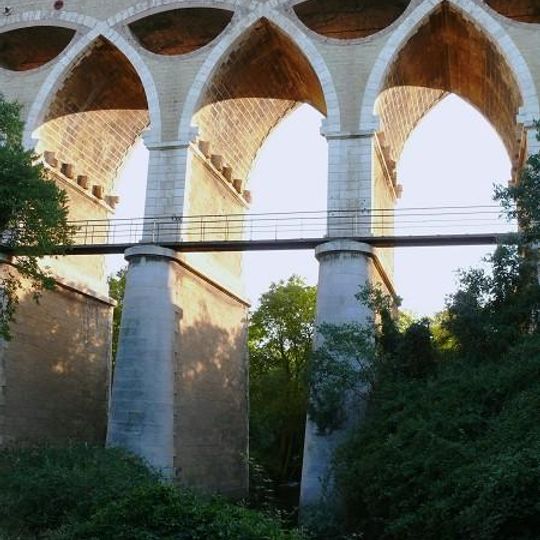
The Viaduc de Saint-Chamas, also called viaduc Saint-Léger, is a masonry railway viaduct over the Touloubre on the Paris-Lyon to Marseille line. It is 385.40 m long with 49 interlocking round arches that cross at a third of their height, resembling a series of pointed vaults, and reaches a maximum height of 31 m. The spandrels are laid in brick-colored stone in a triangular pattern, contrasting with the pale gray piers and arch rings.
The viaduct entered service in 1848, built under the direction of engineer Gustave Desplaces. It belongs to the second period of 19th-century French masonry bridge building, when the constraints of railway profiles led to the construction of many stone viaducts. It was inscribed as a Monument historique by decree of 28 December 1984.
The viaduct is also called viaduc Saint-Léger, after the Saint-Chamas district it crosses. Its 49 arches cross at one third of their height, giving the outline of a series of pointed vaults. Paul Séjourné judged it harshly: "C'est cher et laid." It was listed as a monument historique on 28 December 1984.
The viaduct lies between Saint-Chamas and Rognac stations on the Paris-Lyon to Marseille line, so it is reached on foot from Saint-Chamas rather than from the tracks. View it from the banks of the Touloubre below; the deck carries a metal railing and live railway track, and walking on it is unsafe and prohibited.
The arches of the viaduct are unusually designed: they intersect with each other and create a series of pointed vaults, a technique that engineer Paul Séjourné later criticized. This uncommon building approach is one of the most noticeable features and sets the viaduct apart.
The community of curious travelers
AroundUs brings together thousands of curated places, local tips, and hidden gems, enriched daily by 93,896 contributors worldwide.