Zoo de La Flèche, Wildlife park in La Flèche, France.
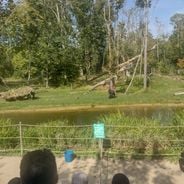
Zoo de La Flèche covers 18 hectares on the Tertre-Rouge hill south-east of La Flèche. Its grounds hold about 1,600 animals of some 160 species, grouped in zones such as the African plain, where Kordofan giraffes, plains zebras, impalas, gemsbok and ostriches share a central area, and Nosy Komba, an immersion space for ring-tailed and ruffed lemurs. A tall pale-timber viewing tower with stacked platforms and a staircase overlooks a grassy enclosure with a shallow pool.
Naturalist Jacques Bouillault settled in 1946 in a forest lodge on the Tertre-Rouge hill southeast of La Flèche and founded the Tertre-Rouge zoological park, the first private zoo in post-war France. By 1957 more than 2 hectares were open to visitors, and in 1971 he opened a large vivarium. After bankruptcy in 1988 the insurer Raymond Da Cunha bought the park and renamed it Zoo de La Flèche; Looping Group acquired it in 2017.
The zoo has been the subject of the France 4 documentary series Une saison au zoo, broadcast from 2014 to 2022, which followed the daily work of keepers and animals. Its name comes from the town of La Flèche, and the site was long called Tertre-Rouge after the hill where Jacques Bouillault settled. Since 2013 guests can stay in twenty safari lodges overlooking the enclosures.
The zoo covers 18 hectares on the Tertre-Rouge hill south-east of La Flèche, so allow several hours to walk between the African plain, the Asian zone and the aquatic area. It is open every day except 25 December and 1 January. Daily shows run from April to the end of October, and animals are fed at set times through the day.
Since 2013 the zoo has offered twenty safari lodges overlooking the animal enclosures, modelled on unusual accommodation in nature reserves. Stéphane Da Cunha presented the project as an attempt to create "the first zoological resort in the world".
The community of curious travelers
AroundUs brings together thousands of curated places, local tips, and hidden gems, enriched daily by 92,789 contributors worldwide.