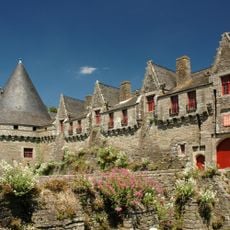
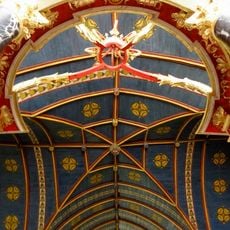
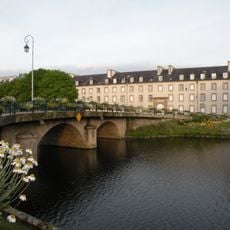
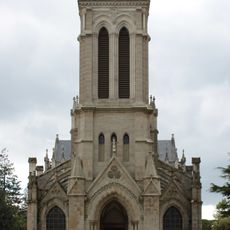
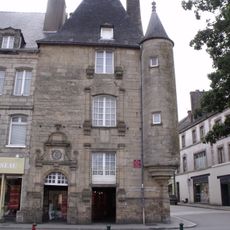
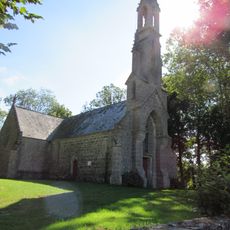
Église Notre-Dame-de-la-Joie de Pontivy, Minor basilica from 16th century in Pontivy, France.
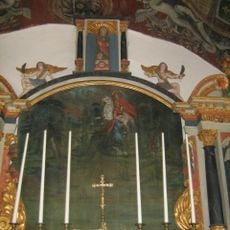
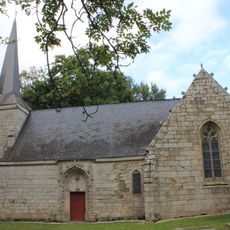
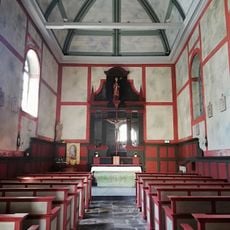
Notre-Dame-de-la-Joie is a granite church built from 1533, with a western portal of two basket-handle bays framed by three colonnettes whose capitals carry the open lozenges of the Rohan arms. The nave has four bays and three vessels, with pointed arcades on square granite piers. The 1725 Louis XV retable encloses a terracotta Holy Family in a large niche, with Saint Ivy above.
Construction began in 1533 with the backing of Claude de Rohan, Bishop of Cornouaille, starting its role as a religious center. The installation of the marble high altar in the 18th century marked a period of artistic enrichment that further refined the sanctuary.
The name Notre-Dame-de-la-Joie comes from a local tradition: during a dysentery epidemic in 1695-1696, the inhabitants vowed on 11 September 1696 to give the Virgin a silver lamp in Saint Ivy's chapel if the plague ceased. The lamp was lit the next day and a procession held; a Pardon is still celebrated on the second Sunday of September.
The sanctuary sits centrally between Bourdonnaye and Anne-de-Bretagne squares and is easily accessible throughout the year. Pedestrian paths from nearby squares allow convenient access, and visitors should allow time to examine the facade details and interior furnishings.
Above the twin western portal, an inscription in Middle French records that the tower was begun on 29 April 1533 by the parishioners of Pontivy, naming J. Pedron and O. Roscoet as miseurs (building managers) and Le Bret as master. The text is cut into the granite and is hard to make out without some practice in epigraphy.
The community of curious travelers
AroundUs brings together thousands of curated places, local tips, and hidden gems, enriched daily by 94,257 contributors worldwide.