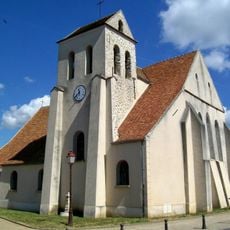
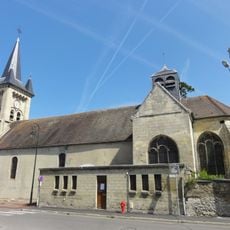
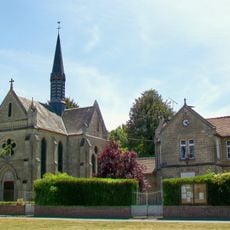
Église Saint-Côme-Saint-Damien de Luzarches, Romanesque church in Luzarches, France
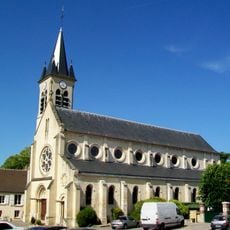
Église Saint-Côme-Saint-Damien is a church built over centuries, combining Romanesque foundations with Gothic and Renaissance additions. The interior contains six nave sections flanked by side aisles, a three-bay choir space with a rounded apse, and a bell tower positioned to the north of the choir area.
A Gallo-Roman building stood here before a Carolingian church; Charlemagne's 775 diploma already names it for Saints Cosmas and Damian. The surviving Romanesque apse dates from the late 11th century, the bell tower and north apse from around 1140. Around 1300 the south apse became a Gothic chapel; in 1537 Jean Guillot raised the tower, and Nicolas de Saint-Michel finished the west facade in 1551. The nave was rebuilt in the 17th century and reworked by Franz Boulogne in the 1880s. It was listed as a monument historique in 1912.
The twin saints Cosmas and Damian, patrons of physicians and pharmacists, are shown on a relief on the 1708 pulpit carved by Claude Collin. A processional banner recalls the pilgrimage of the medical guild to their relics, kept in the north apse until they were stolen in 1990. The church has been called Saint-Côme-et-Saint-Damien since at least Charlemagne's diploma of 775.
The church stands on rue François-de-Ganay at the edge of Luzarches, facing the fields rather than the town centre; its south side looks onto the presbytery garden and the cemetery lies to the north and east. Step back from the building to see the whole exterior. The site is a classified monument historique since 1912.
The relics of Saints Cosmas and Damian, brought from the Holy Land around 1170 by the local lord Jean de Beaumont, were kept in the north apse until they were stolen in 1990. A processional banner depicting the twin saints recalls the pilgrimage of the medical profession to Luzarches.
The community of curious travelers
AroundUs brings together thousands of curated places, local tips, and hidden gems, enriched daily by 93,261 contributors worldwide.