Église Saint-Maximin de Thionville, Catholic church in Thionville, France
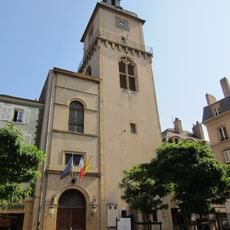
Église Saint-Maximin is a Neoclassical Catholic church built 1755–1759 to a plan by the Metz architect Le Brun. Its light beige stone facade has two square towers with arched louvred openings, a balustrade topped by a stone cross, and a triangular pediment with relief carving above a dark rectangular window. Three green doors open beneath a transom, reached by steps across the base. Inside, the hall layout has three naves and a two-tower front.
A first church, possibly from the 12th century, stood on rue Brûlée; after the 1493 fire the parish rebuilt on the present site, where excavations revealed a seven-sided Gothic choir. The town commissioned a new church from Metz architect Le Brun in 1756, built by Cuny Meaux and Nicolas Geisler and completed in 1759, consecrated in 1760. Bombardment in 1870 led to restoration and reconsecration in 1883, with a cruciform sacristy added; the church was classified as a monument historique in 1984.
The parish belonged to the Abbey of Saint-Maximin in Trier from 930, which gave the church its patron; it was probably dedicated earlier to Saints Paul and Eustace. The high altar of 1760 stands beneath a Rococo ciborium of 1742-1743 brought from the Carthusian monastery of Rettel, and the tabernacle dates from 1900.
The church is accessible during religious services and musical performances held throughout the year. Visitors should check current opening times in advance, as these vary depending on the season and religious calendar.
The six bells were cast in 1921 by Georges Farnier's foundry in Robécourt; the bourdon Maximinus, 207.1 cm across and 5,740 kg, is the largest bell that workshop ever produced. The ring also includes Maria (2,320 kg) and Joanna-De-Arc (277 kg).
The community of curious travelers
AroundUs brings together thousands of curated places, local tips, and hidden gems, enriched daily by 94,231 contributors worldwide.