Église Saint-Pierre d'Orthez, Catholic church in Orthez, Pyrénées-Atlantiques, France
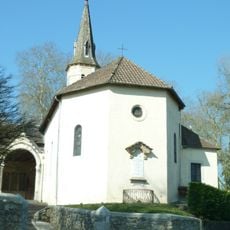
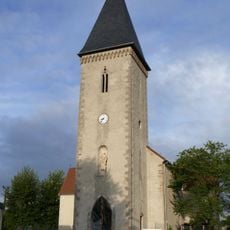
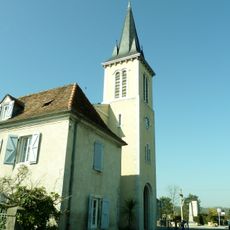
Église Saint-Pierre d'Orthez is a Gothic church built from the 13th to the 19th century. It has a single nave without side aisles, vaulted at 18 metres, the highest in Béarn. The west facade is dominated by an 1865 bell tower by Henri d'Arnaudat, with a clock, rose window and portal. The north wall of the first bay is oblique and has blocked openings.
Construction began in the 13th century when Orthez became the seat of the viscounts of Béarn, starting with a modest choir; work may have paused after Gaston VII's death in 1290 and resumed after Gaston Fébus's death in 1391, when the town received part of the treasure from the Moncade tower. The single nave has no side aisles and a vault 18 m high at the keystone, the highest in Béarn. Protestant troops under the Count of Montgommery seized the church on 15 August 1569. Restored in 1865, it was extended one bay west and given a bell tower over the portal by city architect Henri d'Arnaudat, completed in 1880.
The church keeps two wooden statues, one of Saint Anne, mother of Mary, and one of Saint James, and a sketch by Léon Bonnat for his Panthéon panel of the Martyrdom of Saint Denis, given by the Beaux-Arts in 1924. An organ is recorded here as early as 1388; the present instrument was built by Aristide Cavaillé-Coll in 1870 with 12 stops on two manuals and pedal, enlarged by Maurice Puget in 1958 and restored to the Cavaillé-Coll original by Robert Chauvin in 1982.
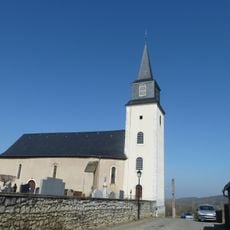
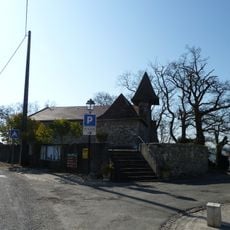
The church stands among parked cars and low vegetation, so parking is directly beside the building. The entrance portal sits at the base of the central tower, beneath the clock, rose window and row of five small pointed arches. The nave has no side aisles, giving an uninterrupted view of the 18 m vault, the highest in Béarn.
The nave has no side aisles, and its vault rises 18 metres to the keystone, the highest in Béarn. A keystone carved with the old three-arch bridge suggests the vault was built before the 16th century, when a fourth arch was added to the bridge. The north wall of the first bay is oblique, showing that the eastern parts were joined to walls that already stood.
The community of curious travelers
AroundUs brings together thousands of curated places, local tips, and hidden gems, enriched daily by 94,028 contributors worldwide.