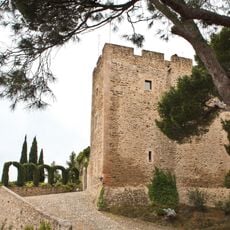
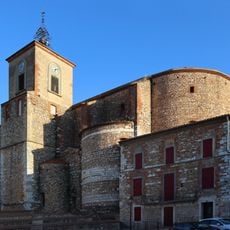
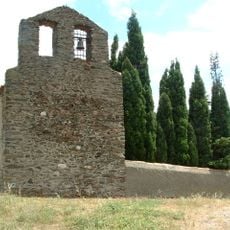
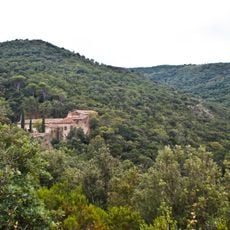
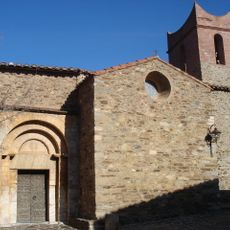
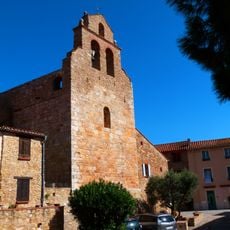
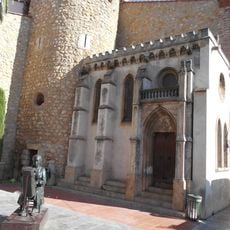
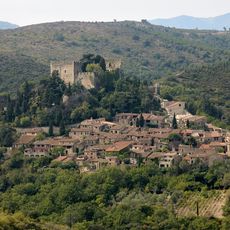
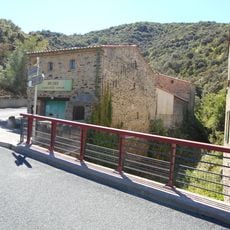
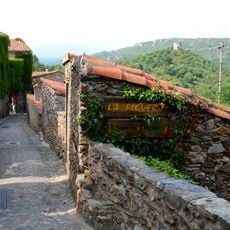
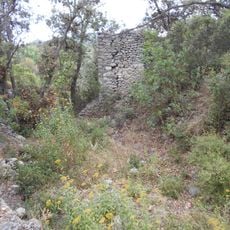
Sant Martí de la Roca, Romanesque church in Camélas, France.
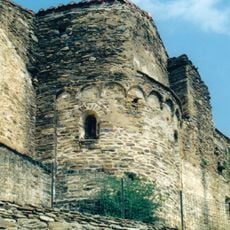
Sant Martí de la Roca is a Romanesque church on a rocky hill south of Camélas. It has a single nave with a semicircular apse decorated with Lombard arcatures on lesenes, and a lateral nave added to the south in the 14th century with a plain apse. The building measures 6.50 by 9.60 metres including a dwelling, and its walls are of light tan and grey stone blocks under a low-pitched tile roof.
The church is documented from 1259, when Guillem de Freixe of Camélas left it a legacy, though its structure points to the 11th century. A south nave with its own semicircular apse was added in the 14th century. In 1637 the Camélas-born priest Honorat Ciuró restored it and retired there as a hermit; it became a hermitage in 1644, was given a dwelling in 1646, closed under the anticlerical laws of 1790 and reopened in 1801.
The name Sant Martí de la Roca refers to the rocky hilltop site, and the chapel was also called Quérubi. From 1644 Honorat Ciuró turned it into a hermitage, and a dwelling was added in 1646; seven hermits lived here in the first two decades. A 12th-century Romanesque Virgin and Child from the church is now kept in the parish church of Sant Fruitós in Camélas.
Access is from the village of Camélas, near Thuir, either by the original footpath or by a winding dirt road that loops around it. The chapel stands on the summit of the hill of the same name, 675 m south of the village and about 190 m above it. Sturdy shoes are needed for the climb.
The chapel stands 190 metres above Camélas, and the view takes in the Mediterranean, the Canigou massif and the Roussillon plain. A 12th-century Romanesque seated Virgin and Child from here is now kept in the parish church of Sant Fruitós in Camélas, where the child raises a hand in blessing.
The community of curious travelers
AroundUs brings together thousands of curated places, local tips, and hidden gems, enriched daily by 94,231 contributors worldwide.