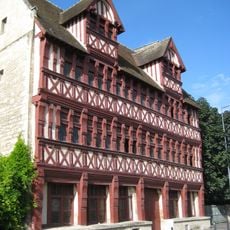
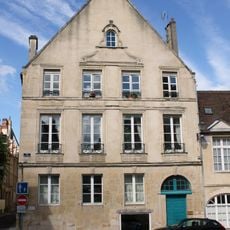
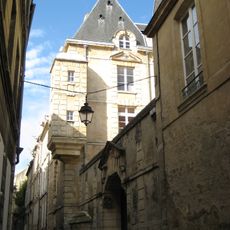
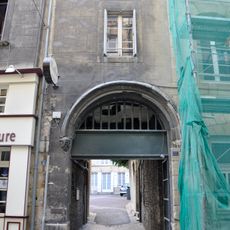
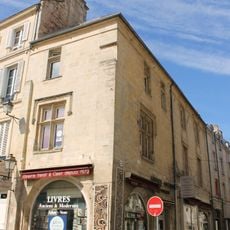
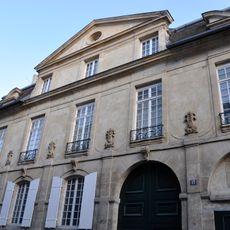
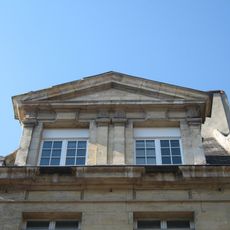
Église Saint-Sauveur de Caen, Gothic church in Place Saint-Sauveur, Caen, France
Église Saint-Sauveur is a Gothic church in Caen with two parallel naves. The 14th-century bell tower and Saint-Eustache nave stand on the east; the 15th-century western nave opens onto rue Froide. A 16-metre pointed arch connects the naves, and the Saint-Eustache apse was rebuilt in Renaissance style in 1546.
The earliest confirmed mention of the church dates from 1152-1153, in a bull of Pope Eugene III; no trace remains of any earlier Romanesque building. The bell tower and the eastern nave, dedicated to Saint Eustace, were built in the 14th century. In the 15th century a second nave was added, making it a hall church, and the Saint Eustace apse was rebuilt in Renaissance style, completed in 1546. Closed during the Revolution, it was reopened in 1802 under the name Saint-Sauveur.
The church was long known as Notre-Dame-de-Froide-Rue, after the street of its single entrance; the name Saint-Sauveur was transferred from the closed Saint-Sauveur-du-marché in 1791 and confirmed in 1802. Until the Revolution, holy water was consecrated once a year in the baptismal fonts at Epiphany, a practice banned by the Council of Rouen in 1072.
The church has been closed to the public since 24 April 2024, when facade inspections led to a safety perimeter on Place Bouchard, rue Saint-Pierre and rue Froide, set two metres out from the walls (sacristy excepted). Interior access is therefore not possible; the building can still be viewed from the square, whose open perspective dates from the post-1944 reconstruction.
The main altar and its tabernacle were placed in the western nave in 1875, not in the 15th century. The two naves are joined by a pointed arch with a 16-metre span, whose construction probably shook the 15th-century eastern apse and led to its rebuilding, finished in 1546.
The community of curious travelers
AroundUs brings together thousands of curated places, local tips, and hidden gems, enriched daily by 92,947 contributors worldwide.