Église Sainte-Marie-Madeleine d'Albi, Roman Catholic church in Albi, France
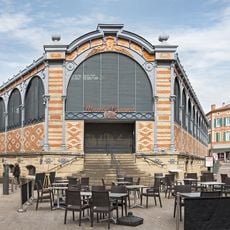
Église Sainte-Marie-Madeleine d'Albi is a 19th-century church whose pinkish-orange brick facade has two levels. Below a stone cornice, a central arched doorway with dark wooden double doors is framed by a stone archivolt and flanked by four round stone columns with carved capitals; two large arched windows with dark gridded glass sit between them, and a stone balustrade caps the level. Steps lead up to the entrance.
Construction took place between 1848 and 1851 under architect Julien Rivet on the site of a former Capuchin convent chapel. The building rose during an era when French religious architecture was influenced by classical design principles.
The choir fresco depicts the entry of Saint Mary Magdalene into heaven, painted by Romain Cazes, who also made the medallions of the nave vault. The first chapel on the right holds a 17th-century wooden statue of Saint John the Baptist, listed as a historic monument. The first chapel on the left serves as the parish war memorial.
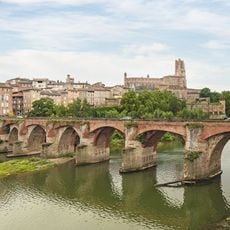
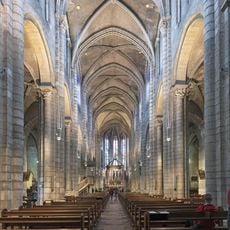
The church stands on the right bank of the Tarn, about 500 metres north of Sainte-Cécile cathedral in the Madeleine district, within the protected sector of the episcopal city. The entrance is reached by steps up to the arched doorway, so access is not level. The nave is 46 metres long and 22 metres wide, with a vault 17 metres high.
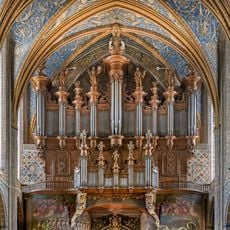
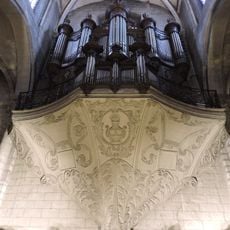
The gallery organ, listed as a historic monument since 2007, was built in 1887 by Eugène Puget of the Toulouse workshop Théodore Puget & Fils with 15 stops; his brother Jean-Baptiste added seven more in 1898, four of them on the pedal. The painted pine case, imitating wood grain, has two bodies joined by a dummy upper case, and the side console keeps 22 stops over two manuals and a German-style right pedalboard.
The community of curious travelers
AroundUs brings together thousands of curated places, local tips, and hidden gems, enriched daily by 93,036 contributors worldwide.