Église Sainte-Thérèse-de-l'Enfant-Jésus de Metz, Modern church in Nouvelle Ville district, Metz, France.
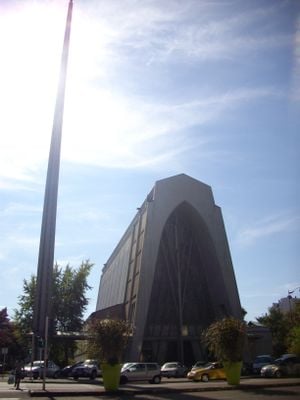
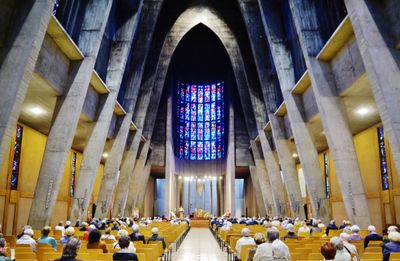
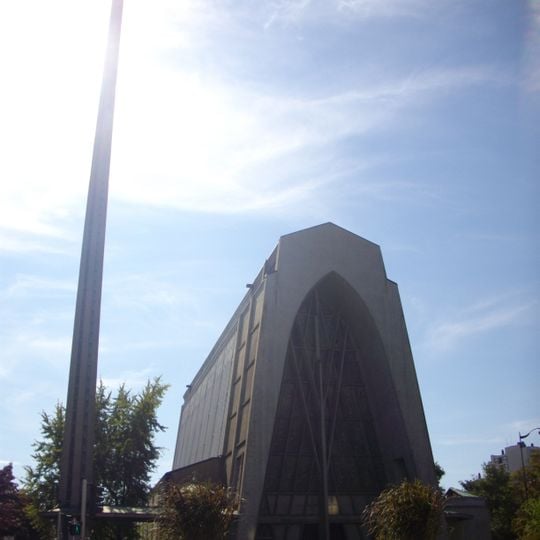
Église Sainte-Thérèse-de-l'Enfant-Jésus is a reinforced-concrete church on Place Philippe-de-Vigneulles in the Nouvelle Ville district. Its plan is an inverted hull 78 metres long, 25 metres wide and 30 metres high, ending in a semicircular apse flanked by three low absidioles. Sixteen slanted concrete pillars, inclined at 9 degrees, meet in pairs to form porticos. The front gable holds a pointed-arch window with a diagonal grid of dark mullions.
The parish was planned from 1932, when a competition selected E. Besh's neo-Byzantine design, rejected in favour of Roger-Henri Expert's modern project approved in 1935. Work began in May 1938; the first stone was blessed on 9 October 1938. The unfinished concrete shell survived Nazi demolition plans during the war, and work resumed in 1947. The church was consecrated on 9 May 1954.
The 1,000 m² of claustra windows were made by Nicolas Untersteller using a personal, previously unused technique; they show the life of Saint Thérèse and the activities of the Metz region. Behind the altar, a large rectangular window sets a grid of blue and red panes above the sanctuary.
The church stands on Place Philippe-de-Vigneulles in the Nouvelle Ville district, on the site of the former Saint-Arnould abbey. The nave is 78 m long, 25 m wide and 30 m high, with fourteen concrete columns, seven per side, and a raised sanctuary platform reached before the blue and red window. The 70 m spire, added in 1963, marks the building from a distance.
A slender spire 70 meters tall was added in 1963 and was designed to symbolize a pilgrim's staff. This vertical element makes the building recognizable from a distance and gives the church a distinct silhouette that catches your eye immediately.
The community of curious travelers
AroundUs brings together thousands of curated places, local tips, and hidden gems, enriched daily by 94,501 contributors worldwide.