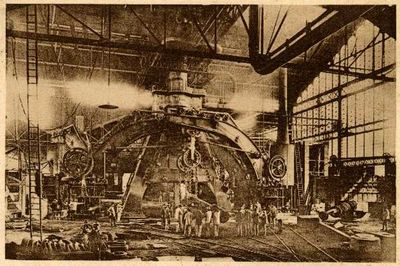
Creusot steam hammer, Industrial heritage monument in Le Creusot, France.
The Creusot steam hammer is a 21-metre-tall forging machine with a 100-tonne falling mass, built by Schneider & Cie in 1877. Its four hollow cast-iron legs, 10.25 metres high, support a 30-tonne table and a 6-metre steam cylinder. The anvil rests on a one-metre oak bed above masonry sunk 11 metres to bedrock. A curved plate on the structure reads "SCHNEIDER & Cie", "CREUSOT" and "1876".
Schneider and Co. completed the hammer in 1877; its first blow fell on 23 September 1877. With a 100-ton hammer it surpassed Krupp's 50-ton "Fritz" of 1861, and a full-size wooden replica stood at the Pavillon Schneider of the 1878 Paris Universal Exposition. Bethlehem Steel bought the patent rights and in 1891 built a near-identical 125-ton hammer; the Creusot machine stayed in service until 1930.
The hammer became the emblem of Le Creusot, and a full-scale wooden replica greeted visitors at the Pavillon Schneider of the 1878 Paris Universal Exposition. In demonstrations of its accuracy, it could cork a bottle without breaking it, crack a nut without damaging the kernel, or tap a watch glass without shattering it.
The hammer stands outdoors at the southern entrance of Le Creusot, place du 8 mai 1945, where it was reassembled in 1969. Visitors walk around its base and look up at the 21-metre frame, the riveted legs and the cylinder; the anvil block and foundation lie below ground level. The 1876 plate reading "SCHNEIDER & Cie, CREUSOT" is on the upper column.
In 1878, during demonstrations at Schneider & Cie, a visiting writer noted that the hammer could cork a bottle without breaking it, crack a nut without damaging the kernel, or tap a watch glass without shattering it. These feats showed that a machine delivering a 100-ton blow could be controlled with great precision.
The community of curious travelers
AroundUs brings together thousands of curated places, local tips, and hidden gems, enriched daily by 92,917 contributors worldwide.