European Court of Human Rights building, Legal institution building in European Quarter, Strasbourg, France
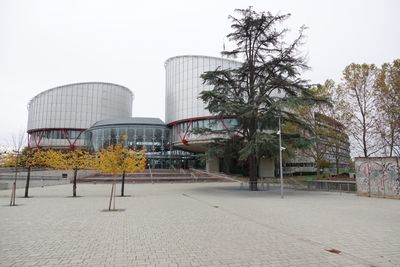
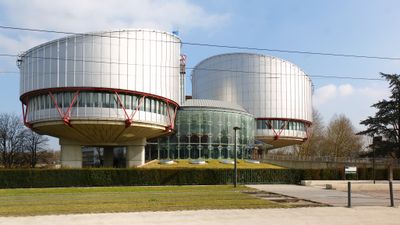
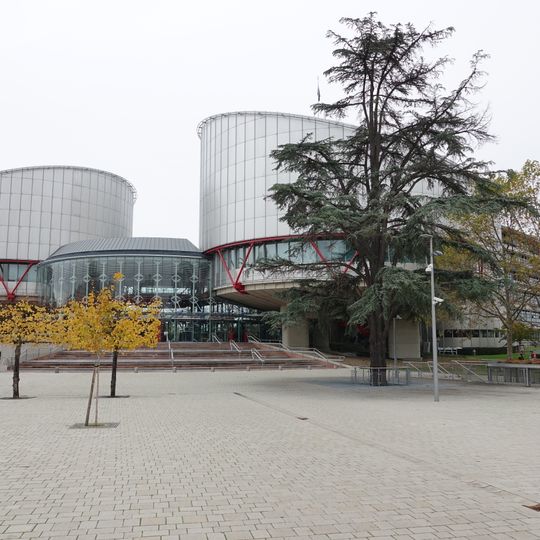
The European Court of Human Rights building was designed by Richard Rogers Partnership and Claude Buche and completed in 1994. Two cylindrical towers clad in grey panels flank a curved glass entrance hall, the taller right tower topped by a thin spire; a red tubular framework links the lower structure, whose circular windows sit above a broad flight of shallow steps on a paved stone plaza. The two towers evoke the scales of justice.
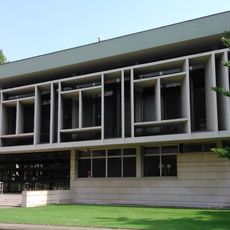
The building was completed in 1994 after the earlier court building from 1965 became too small for the growing number of cases and judges. This new structure allowed the institution to continue its expanding work in a larger and more modern setting.
The two cylindrical towers flanking the entrance are meant to evoke the scales of justice, and the glass hall above it stands for the court's transparency and accessibility to all citizens. The architects, Richard Rogers Partnership with Claude Bucher, aimed at a symbolic landmark rather than a monument, and the building was inaugurated in 1995.
The building is a working court, not a tourist site, so visits are generally limited to organised open days or guided tours arranged in advance. It stands on the allée des Droits de l'Homme, facing the Palais de l'Europe across the Ill, about two kilometres north-east of the Grande Île. The entrance level is reached by a broad flight of shallow steps from the paved plaza, and turnstiles stand inside the glass facade.
Queen Elizabeth II planted a tree on the construction site in 1992 as a symbolic participation in the building's creation. This gesture reflected the importance that Britain placed on the European justice system.
The community of curious travelers
AroundUs brings together thousands of curated places, local tips, and hidden gems, enriched daily by 92,947 contributors worldwide.