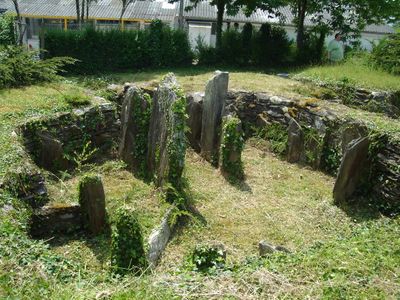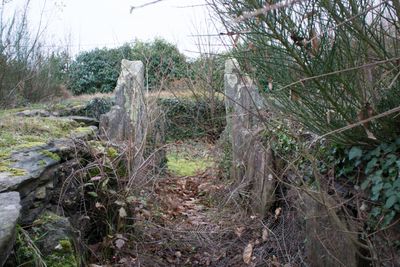
Kerléven cairn, Neolithic burial site in La Forêt-Fouesnant, France.
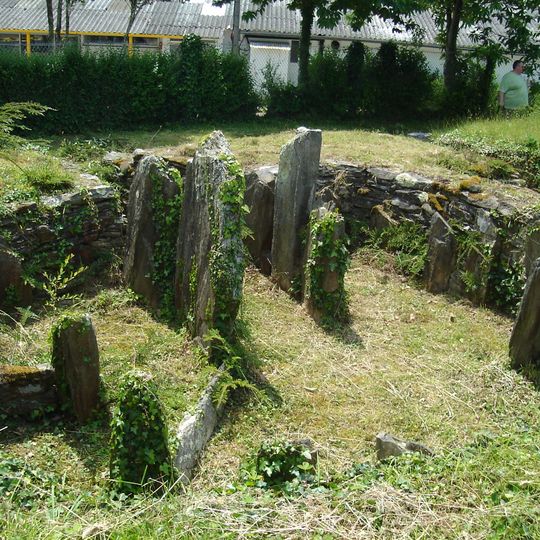
Kerléven cairn is a dry-stone megalithic monument at the top of a promontory above the bay of La Forêt. Two adjoining cairns were built in succession, giving a sub-trapezoidal mound about 25 m long and 8 to 12 m wide, with three chambers reached by corridors. The western cairn survives only as its rounded south-east corner and part of its south facade; the eastern cairn, roughly trapezoidal, holds chambers B and C, separated by a thin 0.80 m partition.
The site was known but absent from 19th-century inventories. In 1937 Pierre-Roland Giot sketched the visible slabs; later overgrowth made it seem lost. In 1960, while a campsite was being built, earthworks levelled its top and destroyed most of the western cairn. Excavations from 1961 to 1965 followed, with partial restoration, and it was classified as a monument historique on 15 April 1965.
Excavations between 1961 and 1965 recovered flint objects, polished axes and broken pottery of the Chassey-Lagozza-Cortaillod culture from the chambers. The two parallel passages of the second cairn open at 195°, and chamber C keeps three corner compartments plus three pillars set in an arc before its north-east corner.
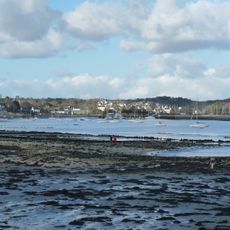
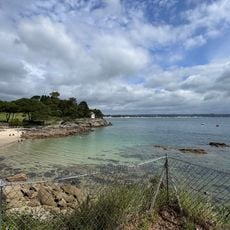
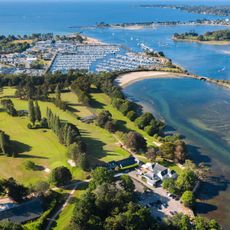
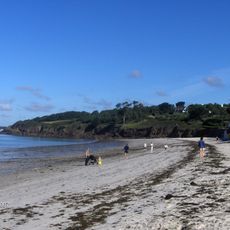
The cairn stands on the Saint-Laurent campsite at Kerléven, on a promontory above the bay of La Forêt. Access is on foot over grass and uneven ground; the western part was levelled in 1960, so the visible remains are lower than the original mound.
The German Wikipedia calls it the third-largest cairn in Brittany after Barnenez and Gavrinis. Radiocarbon dating placed the two chambers around 4825 BCE and 3800 BCE, though the excavators warned the samples were too far apart for reliable results.
The community of curious travelers
AroundUs brings together thousands of curated places, local tips, and hidden gems, enriched daily by 92,893 contributors worldwide.