Hôtel Bullion, Private mansion in 1st arrondissement of Paris, France.
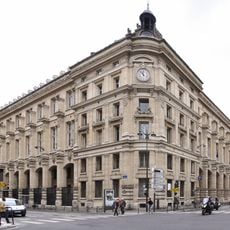
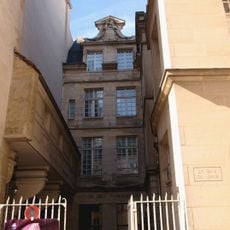
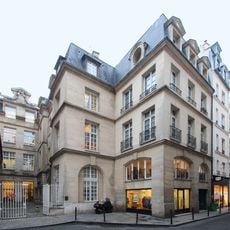
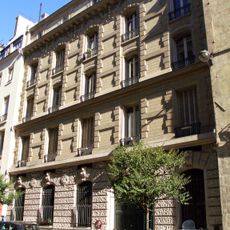
Hôtel Bullion stands at the corner of 9 rue du Coq-Héron and rue du Louvre, the remnant of a 17th-century mansion remodeled in the 18th century. Its light beige stone facade has three tall windows per floor, wrought-iron balconies on the upper level, and a dark red double door under a round arch. A second facade shows a central arch with black iron gates and plaques reading "Caisse d'Épargne et de Prévoyance de Paris" and "Fondée en MDCCCXVIII".
Claude de Bullion, superintendent of finances under Louis XIII, acquired the property in 1613 and architect Salomon de Brosse expanded it in 1614. The redesigned mansion later became a hub for artistic and commercial activity in the capital.
Between the 1770s and the early 1800s part of the mansion served as an auction room, where Alexandre Joseph Paillet conducted his most notable sales. The building later took the name of Barthélémy de Thoinard, a fermier général who occupied it in the 1730s. Since 1844 it has housed the Caisse d'épargne, whose name is carved on the two stone plaques flanking the arch.
The building is an active bank branch, so visitors see only the exterior. From rue du Louvre, look for the arched gateway with its sculpted stone pediment and flagpole; the corner entrance at 9 rue Coq-Héron shows the dark red double door under a round arch. The two stone plaques flanking the central archway read "Caisse d'Épargne et de Prévoyance de Paris" and "Fondée en MDCCCXVIII".
The mansion was "folded" during the Haussmann works to open rue du Louvre, becoming a corner building and losing part of its heritage value. It was bought by the savings banks in 1842, two years before the Caisse d'épargne moved in.
The community of curious travelers
AroundUs brings together thousands of curated places, local tips, and hidden gems, enriched daily by 93,074 contributors worldwide.