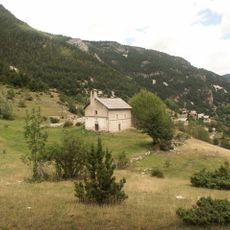
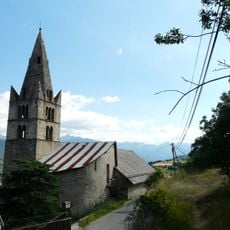
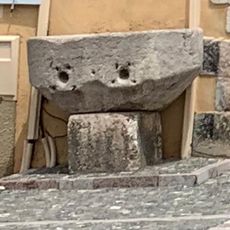
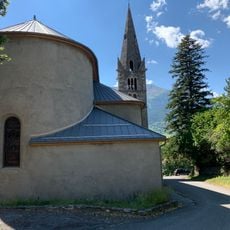
Fontaine pétrifiante de Réotier, Natural spring in Réotier, France.
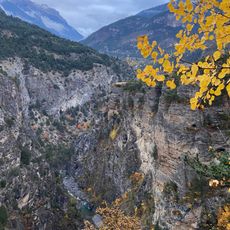
The Fontaine pétrifiante de Réotier is a spring at about 910 m altitude in the Hautes-Alpes, between Guillestre and Briançon. Its water emerges at 21 °C, charged with calcium bicarbonate, and releases carbon dioxide as it flows, depositing calcite at roughly 140 mg/l. This deposit encrusts the surrounding rocks and materials, and the water falls over a broad cliff of brown and tan stone hung with icicles.
The site is fed by the waters of the Saulce, which share their origin with the Plan de Phazy springs; the two resurgences lie two kilometres apart on the Durance fault. The water rises at 21 °C, charged with calcium bicarbonate, and releases carbon dioxide, depositing about 140 mg of calcite per litre. A legend set in 1697 tells of the peasant Antoine, caught in a snowstorm near the vines of Saint-Clément, who took the fountain for a monster before recognising it.
The name comes from the calcite the water leaves behind: about 140 mg per litre, enough to encrust branches, moss and any object left in the flow. A local legend tells of Antoine, a Réotier farmer caught in a snowstorm near the spring on Christmas Eve 1697, who took its silhouette for a monster before recognising it and reaching home at midnight.
The site is accessible via a marked hiking trail that features information panels along the way. Wear sturdy shoes since the ground can be slippery from mineral deposits.
The water carries an unusually high concentration of dissolved minerals that quickly coat objects and cover them in white crust. Some visitors intentionally place objects in the stream to watch how they develop a stone-like layer over time.
The community of curious travelers
AroundUs brings together thousands of curated places, local tips, and hidden gems, enriched daily by 93,135 contributors worldwide.