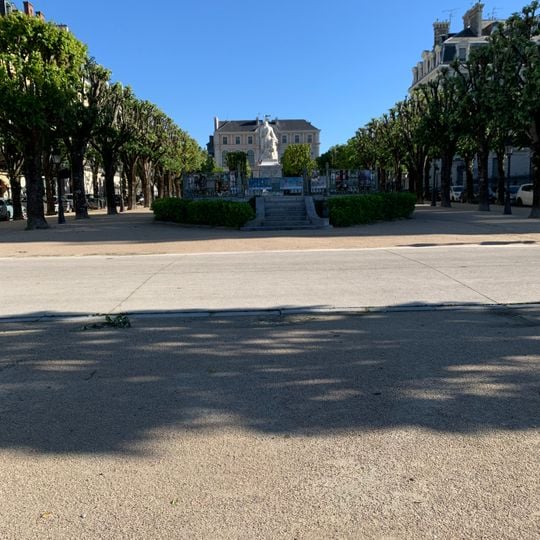
Place Royale, square in Pau, France
Place Royale is a paved square at the centre of Pau, bordered by the town hall, the former Hôtel de France and the boulevard des Pyrénées. A marble standing statue of Henri IV, carved by Nicolas Raggi in 1843 on a base by Jean Latapie, stands on a tall pedestal above a stepped base, flanked by low trimmed hedges. The town hall facade carries the inscriptions "REPUBLIQUE FRANCAISE" and "LIBERTE EGALITE FRATERNITE".
Place Royale was laid out in 1688 on the orders of the États du Béarn to hold a statue of Louis XIV, which was pulled down in 1793 during the Revolution. An unfinished church of Saint-Louis, begun on the site of today's town hall, left ruins for centuries. A decree by Napoleon in 1808, passed through Pau, ordered the wall closing the southern view demolished, opening the square to the Pyrenees. In 1843 a marble statue of Henri IV by Nicolas Raggi was erected.
The name refers to the royal statue the square was built to hold in 1688, not to a royal residence. In the 19th century, being "de la place Royale" meant belonging to Pau's good society. The square's name changed repeatedly: place de l'Égalité in 1793, place Napoléon, place Henri IV, place Nationale, before returning to place Royale in 1850.
The square is easily reached on foot and sits centrally in Pau's old town, where other sights are also located nearby. The arcades provide shelter from bad weather, and there is ample space for sitting and watching the square's daily activity.
The name changed repeatedly: place de l'Égalité from 1793 to 1803, place Napoléon from 1803 to 1815, place Henri IV in 1844-1845, place Nationale in 1849-1850, and place Royale again since 1850. The Louis XIV statue was pulled down in 1793; the marble Henri IV by Nicolas Raggi, on a base by Jean Latapie, replaced it in 1843.
The community of curious travelers
AroundUs brings together thousands of curated places, local tips, and hidden gems, enriched daily by 94,532 contributors worldwide.