Hôpital Marguerite de Flandre, Medieval hospital and historic monument in Seclin, France
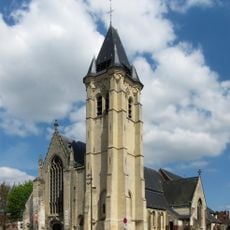
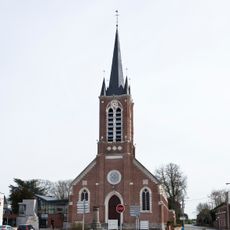
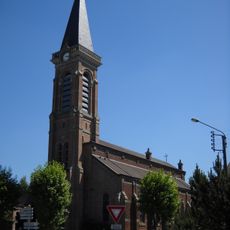
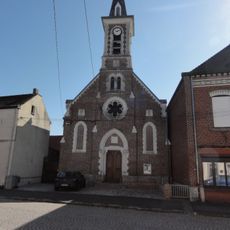
The Hôpital Marguerite de Flandre in Seclin is a former hospital whose surviving buildings date from the 14th to the early 20th century and form a coherent group in Hispano-Flemish Renaissance style. Its north wing holds the oldest parts: the choir rebuilt between 1340 and 1360, the 1533 chapel, the sick ward built in the 15th century and enlarged in the 17th, and an 18th-century sacristy. A square courtyard was laid out in stages between 1635 and 1701. The brick facade runs from a stepped gable with a stone medallion to a square tower with corner quoins and a slate spire, then a lower wing with dormers and an arched entrance.
Marguerite of Constantinople, Countess of Flanders, founded the hospital in 1246 on a manse with adjoining lands and meadows, and Augustinian sisters settled there soon after. The domain covered 300 hectares of land and woods. The last sisters left in April 2013, after more than seven centuries.
The name Notre-Dame refers to the Virgin Mary, to whom the hospital was dedicated. A statue of Marguerite of Flanders, carved by Gustave Crauk in 1880, stands at the centre of the French garden. The last Augustinian sisters left the hospital in April 2013, after more than seven centuries.
The entrance is reached by a 375-metre lime tree avenue laid out by architect Achille Dewarlez in 1850. It ends at a French garden entered through a gate flanked by two pavilions built by Charles Marteau in 1858. The square courtyard, enclosed on its four sides between 1635 and 1701, is the way into the oldest north wing.
A brick wall has separated the patient ward from the chapel since the 17th century, revealing how medieval hospitals solved practical challenges. This arrangement allowed spiritual and medical functions to coexist while remaining distinct.
The community of curious travelers
AroundUs brings together thousands of curated places, local tips, and hidden gems, enriched daily by 93,231 contributors worldwide.