Hôtel de Fécamp, Private mansion in 6th arrondissement, France
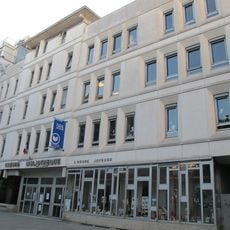
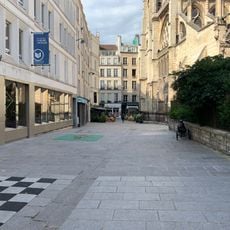
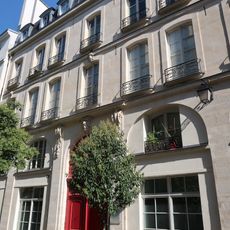
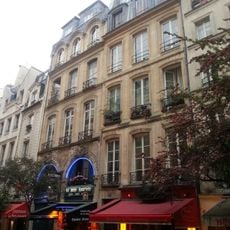
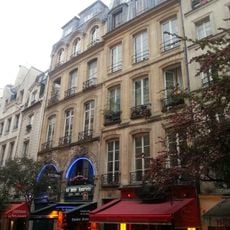
The Hôtel de Fécamp stands at no. 5 rue Hautefeuille, at the corner of the impasse Hautefeuille. Its early 16th-century corner turret projects from a flared corbel base, with lace-like carving on the corbelling and a cornice of pearls and interlace; the turret is capped by a conical roof. The facades and roofs were inscribed in 1947.
The building was originally constructed in 1292 for Guillaume IV de Putot, the abbot of Fécamp, but underwent major reconstruction during the 16th century. This renovation transformed its appearance and gave it the distinctive features visible today.
Nicolas Boucot lived on the first floor until his death in 1699, having assembled more than 18,000 volumes and over 7,000 prints. In the 17th century the house was also frequented by Godin de Sainte-Croix, lover of the Marquise de Brinvilliers, later notorious in the Affair of the Poisons. The street plaque reads Impasse Maître Albert, and a café occupies the ground floor.
The corner tower received monument status in 1948, with the facades and roofs protected since 1947, meaning the building remains visible from the street. Since this is a private residence, visitors can only appreciate its exterior from the surrounding streets.
Stanislas Leszczyński, Duke of Lorraine, died in 1766; the Lorraine archives were then brought to Paris and stored in this building until 1790, when they were transferred to the National Archives. The corner turret was separately classified as a monument historique on 5 January 1948, while the facades and roofs had been inscribed on 18 February 1947.
The community of curious travelers
AroundUs brings together thousands of curated places, local tips, and hidden gems, enriched daily by 93,898 contributors worldwide.