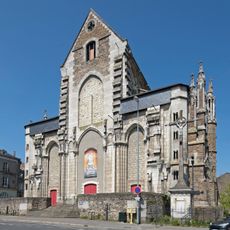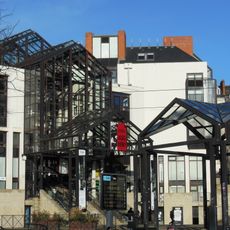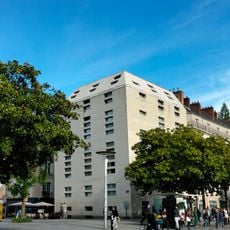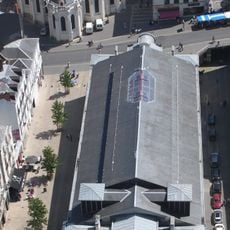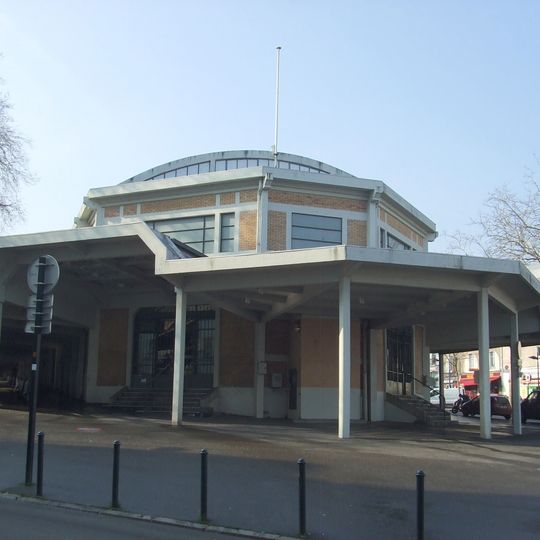
Marché de Talensac, Historic covered market hall in central Nantes, France.
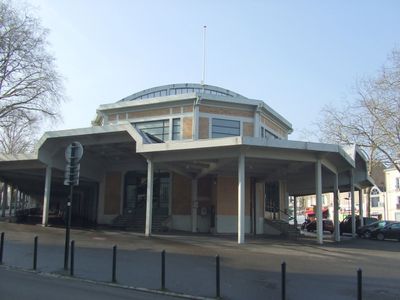
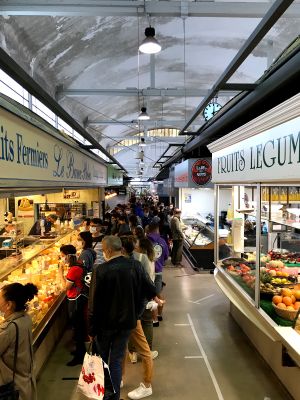
Marché de Talensac is a covered market hall in central Nantes with more than 150 stalls organized by color: green zones for producers, yellow for fruit vendors, and blue for artisans. The interior feels organized and varied, with different sections that let visitors move easily between product types.
The market stands on the site of the municipal slaughterhouses inaugurated on 15 October 1829. Their activity moved to Rezé on 16 October 1933, and mayor Léopold Cassegrain launched an architects' competition that December. Henri Vié father and son, Georges Desfontaines and builder Jean Le Guillou were chosen on 23 May 1934 for a three-tier market built into the hillside.
The market's name comes from the Talensac street bordering it to the north, and Nantes residents nicknamed the earlier slaughterhouse on the site "la tuerie aux bestiaux". The 1934 competition programme split the site into three concentric sections: a closed hall for butchers and charcutiers, a covered hall for butter, egg and poultry sellers, and an open-air area for vegetables and small goods.
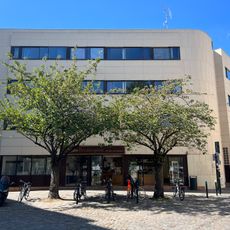
The market occupies a sloping site between rue Talensac, rue Jeanne-d'Arc, rue Basse-Porte and rue de Bel-Air, with the closed hall at the top and the open-air market below. Ten entrances serve the hall: seven at ground level and three reached by steps of 3, 5 or 7 risers. A 1,145 m² basement holds 100 individual cellars.
The market stands on the site of the municipal slaughterhouses inaugurated on 15 October 1829, whose activity moved to Rezé on 16 October 1933. The 1934 competition brief asked for three concentric sections: a closed hall for butchers and charcutiers, a covered market for butter, egg and poultry sellers, and an open-air market for vegetables and sundries.
The community of curious travelers
AroundUs brings together thousands of curated places, local tips, and hidden gems, enriched daily by 94,043 contributors worldwide.