Mosaics of the basilica of Grand, Roman mosaic site in Grand, France
The Mosaics of the Basilica of Grand is a 232 m² polychrome floor mosaic from the reign of Caracalla, the largest in ancient Lorraine. Its tessellae are local limestone except the red, brought from the Ardennes. A meander and two-strand braid frame the carpet; the emblema, only a third preserved, shows two figures, one masked and holding a pole.
The mosaic dates to the reign of Emperor Caracalla (211–217) and floored a rectangular room, 14.12 by 13.87 m with a 5.43 m western apse, in a Roman building at Grand. An angle was found in 1873 under the Maison des Sœurs; in May 1883 Félix Voulot, curator at the Épinal museum, uncovered the full 232 m². The mosaic and its basilica were classified as monuments historiques on 19 January 1884.
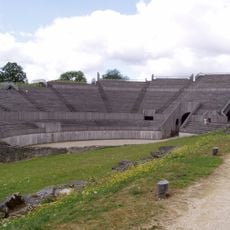
The four corner animals are a tiger, a panther, a bear and a boar; the bear and tiger face off while the panther chases the boar, imagery often linked to the venationes held in Grand's amphitheatre. Comparable animal combats appear on mosaics at Reims, Nennig, Bad Kreuznach and Vallon, dated between 180 and 250.
The site is covered by a protective structure that allows access while shielding the delicate artwork from weather. Visitors can view the mosaic year-round in a controlled environment.
The emblema uses black tesserae for the background instead of the usual white, and its cubes measure only 0.5 to 0.8 mm². The red tesserae come from the Ardennes, while the rest of the limestone was quarried locally, suggesting itinerant teams worked on site.
The community of curious travelers
AroundUs brings together thousands of curated places, local tips, and hidden gems, enriched daily by 94,549 contributors worldwide.