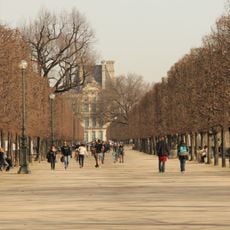
Rectangular south basin, Fountain in Tuileries Garden, France
The Rectangular South Basin is one of the two large octagonal-cornered pools that André Le Nôtre laid out in the Tuileries Garden in the 1660s, set on the south side of the central axis. Its stone rim borders a flat sheet of water that mirrors the trees and sky, and it sits on the terrace level above the garden's lower walks.
The south basin was dug in 1664 when André Le Nôtre remade the Tuileries Garden for Louis XIV, replacing an earlier parterre. Its octagonal form, visible in the stone coping, belongs to that campaign. In the 18th century the basin was surrounded by clipped yews and used for small boats.
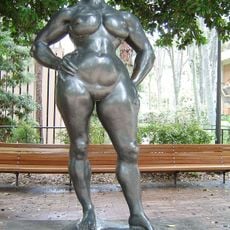
The two south basins are round in the north garden and rectangular in the south, and the south pair frames the Grand Carré. Since 1990 they have held bronze figures by Aristide Maillol, including a seated woman, placed on the basin rims. Visitors walk the gravel between them and rent the green metal chairs stacked nearby.
The south basin sits on the garden's southern side, along the axis running from the Louvre toward Place de la Concorde; gravel paths lead to its rim. Benches line the surrounding terraces, and the ground is level and firm, so wheelchairs and strollers can circle it. The garden gates nearest the Louvre open earliest, giving access before the crowds arrive.
The south basin sits on the same axis as the Louvre and the Champs-Élysées, so from its rim the Grande Allée lines up with the Arc de Triomphe. André Le Nôtre extended this axis westward in the 1660s, and it still organizes the garden's perspective today.
The community of curious travelers
AroundUs brings together thousands of curated places, local tips, and hidden gems, enriched daily by 93,278 contributors worldwide.