Pont suspendu de Saint-Symphorien, Heritage footbridge across Loire River in Tours, France
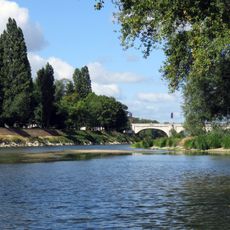
Pont suspendu de Saint-Symphorien is a pedestrian bridge with a suspension system that crosses the Loire River and joins the Saint-Symphorien district to central Tours. The structure uses steel cables to support pedestrian and bicycle traffic while excluding motor vehicles.
A royal decree of 22 March 1841 authorised the bridge, and the Seguin brothers built it from 1845 to 1847 on the site of the medieval Pont d'Eudes, demolished in 1784. Marc Seguin's wire-cable suspension system, first used in 1825, replaced the iron chains of earlier bridges. The crossing was tolled until the city bought the concession in 1925; French troops blew it up in 1940 and German forces in 1944.
The bridge takes its name from the Saint-Symphorien district on the right bank, which in turn refers to the martyr Symphorien of Autun. Until the city bought the concession in 1925, tolls were collected at pavilions at each end, each lit by five street lamps. The bridge helped settle workers of the Paul-Bert district, who crossed daily to work in Tours.
The bridge crosses the Loire in two unaligned sections via the small Île Aucard, where a municipal stadium and water-pumping station stand. The southern section has three spans and measures 240 m; the longest span is 70 m. The deck is 5.4 m wide, with a metal railing and a low kerb separating pedestrians from cyclists.
The bridge crosses the Île Aucard, which holds a municipal stadium and the water syndicate's pumping station; the station draws drinking water from 80 m below the Loire sands. Remains of a Late Roman bridge, the Pont de l'Île Aucard, were found in 2000 about 20 m east on the right bank and are visible only at low water.
The community of curious travelers
AroundUs brings together thousands of curated places, local tips, and hidden gems, enriched daily by 94,125 contributors worldwide.